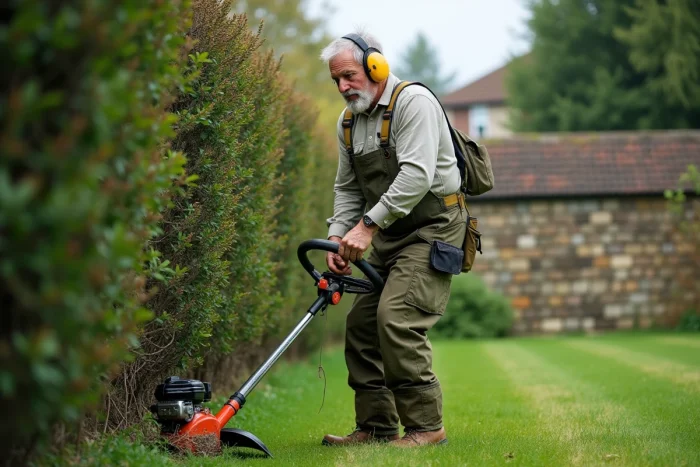
Your land is overrun with brambles, tall grass spills over the slope, and the mower can do nothing. It’s time to consider the thermal brush cutter. This powered tool cuts where no mower can go, on slopes, around trees, in overgrown plots. However, you need to choose the right model, as the differences in power, comfort, and noise between two machines can be considerable.
Noise and local regulations: the criterion that guides overlook
Before discussing engine or blade, ask yourself a practical question: what time do you plan to clear the brush? Since the European directive 2000/14/EC, every thermal brush cutter sold in the EU must display its guaranteed acoustic power level. This figure, expressed in decibels, allows for an objective comparison of the noise of a Stihl model with that of a Husqvarna, for example.
In France, several municipalities have tightened the rules. Cities like Paris, Lyon, or Strasbourg incorporate noise limitations into their municipal decrees. In the suburban areas of Île-de-France and PACA, some municipalities restrict the use of thermal tools to specific time slots, with possible checks by the municipal police.
This regulatory framework makes two criteria strategic for an individual: the actual noise level of the machine and its vibrations. A noisy model used on a Sunday morning can result in a fine, not to mention neighborhood conflicts. Always compare the decibels listed on the technical sheet, and prefer machines equipped with an effective anti-vibration system.
To compare models based on these criteria, the detailed sheets on top-debroussailleuse-thermique.com facilitate the comparison of technical characteristics.
Engine displacement: matching power to the terrain
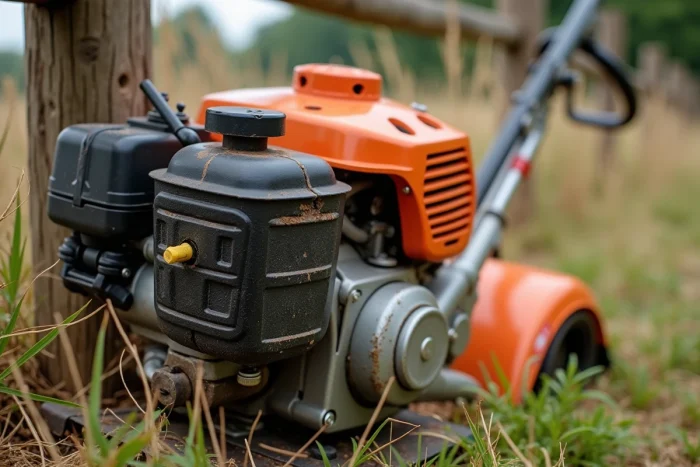
You may have noticed that a small engine struggles in thick brambles while a large engine quickly tires the user on a simple lawn edge? The displacement, expressed in cubic centimeters, directly determines the available power.
Small displacements for regular maintenance
Low-displacement engines are suitable for regularly maintained gardens. They cut tall grass, grasses along the fence, and regrowth along walls. Their lightweight makes them manageable, even for extended sessions.
Medium and high displacements for overgrown areas
An overgrown area or one overrun with brambles requires a higher displacement. More powerful engines drive blades or discs capable of cutting woody stems. The compromise lies between the necessary power and the weight you are willing to carry for an hour or two.
Another distinction to know: the 2-stroke engine and the 4-stroke engine. The 2-stroke is lighter, requires a fuel-oil mixture, and produces more exhaust gases. The 4-stroke is heavier, runs on unleaded gasoline without pre-mixing, and generally operates more quietly. For residential use, the 2-stroke remains the standard due to its favorable power-to-weight ratio.
Cutting system: line, blade, or disc depending on the vegetation
The choice of cutting system radically changes what the machine can do. This is the point where many buyers go wrong by choosing a model unsuitable for their vegetation.
- The nylon line head is suitable for soft grasses and edge finishing. It is economical, easy to reload, and limits the risk of dangerous projectiles. It is the right choice for a regularly mowed garden where there are areas inaccessible to the mower.
- The three or four-tooth blade tackles dense grasses, thick nettles, and young shrub shoots. It requires a sufficiently powerful engine to maintain its rotation speed in resistant vegetation.
- The steel or tungsten-tipped disc is reserved for heavy-duty work: established brambles, stump regrowth, woody underbrush. Its use requires a quality harness and good machine control.
Most thermal brush cutters accept several interchangeable cutting systems. Check compatibility before purchase: the diameter of the drive shaft and the engine power determine the usable accessories.

Harness and handle: comfort that makes a difference over time
Why does this criterion deserve special attention? Because a thermal brush cutter weighs several kilograms, and it is carried on the shoulder or back throughout the session. A poor harness turns an hour of work into a nightmare for the back and shoulders.
The simple harness, with one strap, is sufficient for short interventions on flat terrain. The double harness distributes the weight over both shoulders and reduces fatigue during long sessions or on sloped terrain. Some professional models offer a complete back harness with lumbar protection, suitable for intensive use.
The handle also influences the precision of the action. The bicycle-type handlebar offers good lateral control over large flat surfaces. The loop handle, more compact, facilitates work in cluttered areas, between trees or along walls.
Thermal brush cutter and ecological garden maintenance
An aspect little covered by traditional guides concerns how to clear brush without destroying local biodiversity. Practices of differentiated clearing are developing, consisting of deliberately leaving refuge areas for small wildlife during the machine’s passage.
In concrete terms, this means not systematically mowing the entire area to the same height. Keeping strips of tall grass around the perimeter, avoiding clearing during the ground nesting period, and adjusting the cutting height according to the zones: these simple gestures preserve pollinating insects and small animals without compromising the overall appearance of the garden.
The choice of a thermal brush cutter suitable for your terrain, vegetation, and neighbor constraints determines the final result as much as the cutting technique. A model too powerful for a small city garden will be noisy and cumbersome. An undersized machine facing a bramble slope will waste your time and prematurely wear out the engine.
Take the time to check the displacement, the compatible cutting system, and the displayed noise level before placing your order.