A cotton organic and wood teething ring recalled for a risk of breakage, a swaddle removed from the market, a toy phone with accessible button batteries for an infant: in just a few weeks, RappelConso has published several alerts about common childcare products. These recalls do not concern obscure brands. They affect items sold in supermarkets and on marketplaces, sometimes marketed as natural or ecological.
When preparing for a baby’s arrival, vigilance regarding product safety is as important as choosing the right equipment.
Baby product recalls: the checks that baby registries overlook
One creates their baby registry relying on online reviews, recommendations from friends and family, and sometimes a reassuring label. The “organic” or “natural” certification on packaging does not protect against manufacturing defects.
In September 2026, the PAPATE teething ring, made of organic cotton and wood, was recalled after a risk of breakage that could lead to the ingestion of a fragment was detected. The notice was published on RappelConso on September 1, 2026, and updated on September 25. At the same time, Puckababy issued a recall notice for its “Mini” swaddle model.
Before using a childcare accessory purchased a few months ago, checking the model and batch on RappelConso should become a reflex. You can find all you need to know about Baby Care to keep up with equipment news and ongoing alerts.
- Check the Toys category on RappelConso after each purchase and at least once a month for products already in use.
- Do not rely solely on “organic,” “natural,” or “ecological” labels: these labels pertain to composition, not mechanical resistance.
- Keep the exact reference and batch number of each product to facilitate verification in case of an alert.
Button batteries in baby toys: an underestimated danger
Light or sound toys for infants often operate with button batteries. When the compartment does not close properly or a screw is missing, a child can extract the battery and swallow it. The consequences are severe: internal burns within hours.
Several recent recalls illustrate this risk. A star-shaped light stick was removed from sale because its button batteries were accessible. A Kim’play toy phone had the same defect. These products were distributed in mainstream retail stores.
A screw-secured and pressure-resistant battery compartment is the primary safety criterion for any toy intended for a child under 3 years old. Upon receipt, check that the screw is in place and does not loosen by hand.
RSV prevention and housing hygiene for infants
Bronchiolitis remains a major concern for parents of infants. The respiratory syncytial virus (RSV) circulates actively every fall and winter, and prevention measures start at home.
The Ministry of Health, in its “Bronchiolitis: Questions/Answers for Parents” sheet updated on September 18, 2026, reminds us of concrete actions. Limiting visits before the child is 3 months old reduces the risk of exposure. Daily ventilation of the home and wearing a mask in case of respiratory symptoms in the vicinity complete this protection.
These recommendations are not always easy to apply socially. Asking family to postpone a visit or to wear a mask can create tensions. It is better to explain this in advance, from the end of pregnancy, rather than at the moment when the newborn is already settled at home.
Arranging the baby’s room to limit respiratory irritants
Daily ventilation is not only about RSV prevention. Volatile compounds emitted by new furniture, paints, or certain textiles linger in a closed space. Ventilating the room for at least ten minutes a day, even in cold weather, allows for air renewal without significantly cooling the room.
Regarding the choice of textiles in direct contact with the infant (sheets, sleeping bags, bodysuits), feedback varies by brand and range. The Oeko-Tex label remains a reliable benchmark for limiting exposure to irritating substances, but it does not exempt you from washing each new textile before first use.
Development toys and connected accessories: sorting the useful from the superfluous
The market for connected accessories for babies has expanded in recent years: sleep monitors, connected scales, app-controlled nightlights. Some of these devices meet a real need for monitoring. Others add complexity without measurable benefit for the child.
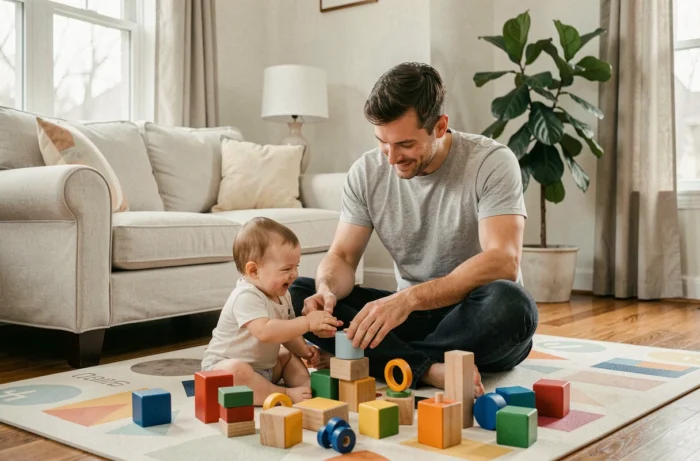
For classic development toys (rings, rattles, sensory cubes), mechanical simplicity remains the strongest safety guarantee. Fewer electronic components mean fewer risks related to batteries, small detachable parts, or malfunctions.
When considering a connected object, the useful question is not “Is it innovative?” but “Does this device help me make a concrete decision for my child’s health or safety?” A sleep monitor that tracks respiratory constants meets this requirement. A connected nightlight controlled from the couch, much less so.
Choosing a development toy suitable for the first months
Before 6 months, an infant primarily explores through touch and mouth. The most suitable toys are those that can withstand chewing without fragmenting, that do not have small removable parts, and whose materials can withstand regular washing. A solid untreated wood rattle or a natural rubber ring meets these criteria without requiring assembly instructions.
Check each product on RappelConso before and after purchase, limit visits in the first weeks, and prioritize mechanical simplicity for development toys: these actions cost nothing and cover most of the documented risks in 2026. An infant’s well-being depends less on the quantity of equipment than on the rigor with which it is selected and monitored.