
The French women’s magazine market is undergoing a rapid transformation. Print sales are declining, digital is supporting circulation in some segments, and advertising investment in the press fell between 2019 and 2024, shifting to digital players. In this context, comparing women’s magazines in 2025 is less about listing titles and more about assessing their ability to maintain a strong editorial identity while diversifying their revenue streams.
Social-to-print conversion: the true measure of a women’s magazine’s strength
A title with millions of followers on Instagram or TikTok does not necessarily generate paid subscriptions. Most women’s magazines produce free social media content (beauty videos, fashion carousels, short interviews) without a clear mechanism for directing audiences to paid print or digital subscriptions.
The titles that succeed in converting followers share one thing: they reserve content for subscribers that is not available on social media. Long-form features, in-depth investigations, exclusive photo portfolios. This partial paywall deliberately creates a barrier between free and paid content.
Cosmopolitan France illustrates this approach, combining an editorial repositioning with a targeted social media presence. The goal: turn digital audiences into regular readers, not just viewers of fleeting content.
To explore how this works and choose the right plan, a guide to women’s magazine subscriptions lets you compare the available offers title by title.
High-end women’s magazines: Elle, Vogue, Marie Claire face declining print sales
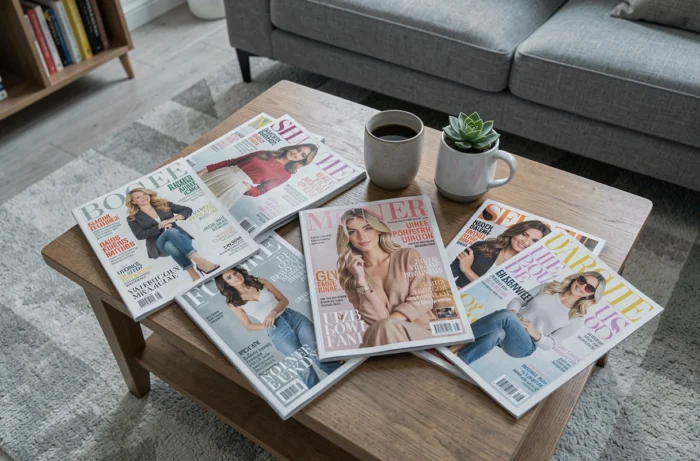
The historic trio—Elle, Vogue Paris and Marie Claire—remains the benchmark in the premium segment. Their positioning is built on polished art direction, collaborations with renowned photographers and privileged access to fashion houses.
Vogue Paris embraces a smaller but loyal readership, willing to pay for a magazine as an object that stands apart from digital feeds through its art direction and print quality.
Elle takes a different approach, with a weekly publication schedule that demands an intense production pace. The title covers a broad range of topics (fashion, society, culture, beauty) and focuses on responding quickly to current events. Its digital circulation has grown in recent years, partly offsetting the decline in print.
Marie Claire occupies a middle ground. The magazine has expanded its society and advocacy sections, targeting readers who want more than a catalogue of trends. This editorial direction helps it stand out in a niche where competition also comes from independent online media.
Mainstream women’s magazines: Femme Actuelle, Cosmopolitan, Grazia
The mainstream segment faces different constraints. Subscription prices are low, page counts are limited, and profitability depends heavily on advertisers. The decline in press advertising investment, documented by the Conseil d’État between 2019 and 2024, is particularly challenging for these titles.
- Femme Actuelle relies on a loyal readership and broad topical coverage (cooking, health, psychology, celebrities). Its model is built on an affordable price and a strong presence at newsstands.
- Cosmopolitan targets 18–35-year-olds with an irreverent tone. Its recently launched strategy to win readers back focuses on an editorial reset and better integration of social media and subscriptions.
- Grazia focuses on weekly fashion and celebrity news, with a compact format whose design is reminiscent of a mook while remaining rooted in the weekly magazine cycle.
The key concern for these titles: reliance on advertising makes their business model vulnerable to budgets shifting to digital. Magazines that fail to develop alternative revenue streams (events, e-commerce, integrated sponsored content) see their margins shrink year after year.
What to consider when choosing a women’s magazine subscription in 2025
Comparing women’s magazines without a framework means comparing products that serve different purposes. A mainstream weekly and a premium monthly do not meet the same needs.
- Publication frequency determines the type of content: a weekly focuses on current events and shorter formats, while a monthly or quarterly allows for in-depth features and more ambitious art direction.
- The editorial-to-advertising ratio varies considerably from one title to another. Some magazines devote nearly half their pages to advertisers, which inevitably leaves less room for editorial content.
- The digital offering included with a print subscription varies by publisher: some include access to an enhanced digital edition, while others offer only a PDF of the print version.
- The editorial line deserves close attention across several issues. A magazine may present itself as socially engaged on the cover while offering very conventional content inside.
We find that readers who are most satisfied with their subscriptions are those who chose a title based on how they actually read (quick reads on the commute, longer weekend reading, fashion inspiration, or in-depth articles) rather than on the title’s name recognition.
Women’s magazines and advertising: a delicate balance
The question of advertising support for the press remains open. Eligibility for support schemes depends on a publication’s status, meaning that not all women’s magazines benefit from the same mechanisms.
This regulatory distinction could create an imbalance between titles recognized as news publications and those classified as specialist or entertainment press. A women’s magazine that publishes social investigations could make a case for reclassification, while a title focused on fashion and beauty would probably remain outside the scope.
The broader trend is clear: women’s magazines must develop their own monetization strategies. The titles that survive this decade will be those that have succeeded in turning their brand into an ecosystem: print magazine, digital editions, events and an engaged community willing to pay for content it cannot find elsewhere.