
The ducted air conditioning market in Montpellier is going through a pivotal period. The revised European F-Gas regulation, adopted in 2024, mandates a gradual reduction of refrigerants with high global warming potential. Daikin and Carrier, two historical manufacturers in the sector, are adapting their residential ranges accordingly.
Choosing a ducted system today commits the owner to a long lifespan. The technical decisions made at installation will determine maintenance costs for the next fifteen to twenty years.
Refrigerant R32 or R410A: what changes concretely for an installation in Montpellier
Recent ducted ranges from Daikin (SkyAir and Residential) are now primarily offered with R32, which has a significantly lower GWP than R410A. Carrier is following the same path with R32 for residential applications and HFO blends (like R454B) for certain tertiary applications.
For a Montpellier homeowner, the question is not theoretical. A ducted system installed today with R410A is likely to face a gradual increase in the cost of refrigerant top-ups over the years, as the availability of this gas decreases in the European market. R32 is expected to have better longevity in the medium term.
Professionals offering ducted air conditioning from Daikin and Carrier at competitive prices logically direct their quotes towards R32 references, aligning the initial cost with regulatory trajectories without significant extra costs compared to older ranges.

Noise level of Daikin and Carrier ducted systems: what field feedback says
Acoustic comfort is often an underestimated criterion when choosing a reversible air conditioning system. In recent constructions in the Montpellier agglomeration, with BA13 ceilings and enhanced insulation, the residual noise from a poorly sized or poorly installed ducted system quickly becomes noticeable.
Carrier highlights optimized boxes and fans to reduce noise from indoor and outdoor units in its latest residential ranges. Daikin, on its part, uses Swing Inverter compressors whose speed modulation limits noise spikes at startup.
What installers observe in Hérault
Field feedback diverges on one point: the actual noise level depends as much on the quality of installation as on the chosen equipment. A duct network poorly insulated acoustically or an undersized plenum negates the benefits of the quietest compressor. Experienced installers in Montpellier emphasize the treatment of connections and wall penetrations, a work area that does not always appear in entry-level quotes.
However, in well-executed installations, occupants report barely audible operation in night mode, even in rooms located directly next to the plenum.
Room-by-room control: Daikin and Carrier facing real zoning
A ducted system distributes air through a network of ducts from a single indoor unit. The commercial promise is for a uniform temperature throughout the house. The technical reality is more nuanced.
- Without a zoning system, all rooms receive the same airflow, creating temperature discrepancies between south-facing and north-facing rooms, a common case in Montpellier villas.
- Compatible zoning solutions (motorized dampers, third-party systems like Airzone) allow for independent control of each zone with a dedicated thermostat, but add a significant cost to the initial project.
- Daikin offers management interfaces compatible with certain third-party zoning systems, while Carrier integrates control options into its recent residential ranges. The available data does not allow for a clear conclusion on the superiority of one or the other on this specific point.
The sizing of the duct network remains the determining factor. A thermal engineering office capable of calculating losses room by room offers a much better guarantee of comfort than a brand choice alone.
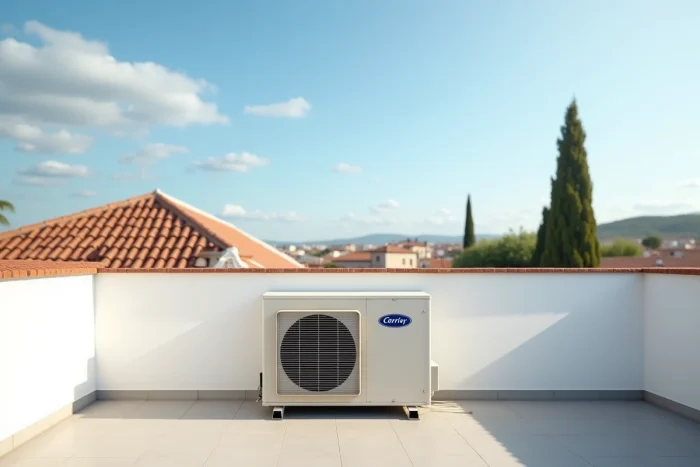
Maintenance and upkeep of a reversible ducted system: points to monitor in the Montpellier climate
Montpellier experiences long, hot summers with episodes of wind carrying dust (tramontane, mistral). These conditions put more strain on filters and exchangers than in other French regions.
Maintenance frequency and points of vigilance
Regulations require mandatory maintenance every two years for systems containing more than two kilograms of refrigerant. A residential ducted system generally exceeds this threshold. Beyond the legal obligation, professionals in Hérault recommend cleaning the filters every three to four months during intensive operation periods.
Specific points to monitor:
- Clogging of the return filter, which reduces airflow and degrades the energy efficiency of the inverter compressor.
- The condition of ducts in unventilated attics, where condensation can occur if the insulation of the air distribution network is insufficient.
- The proper functioning of condensate drainage, as blockages can cause leaks in false ceilings, a costly disorder to repair.
An annual maintenance contract with a local installer allows for the detection of these problems before they lead to breakdowns or excessive consumption. The cost of preventive maintenance remains far lower than that of emergency repairs during a summer heat peak.
Choosing between Daikin and Carrier for a ducted system in Montpellier: the real decision criteria
Both brands offer reversible ducted ranges with R32, featuring inverter compressors and comparable energy performance levels on paper. The choice often comes down to other factors.
The availability of spare parts and the density of the network of certified installers in Hérault weigh heavily over time. Daikin has a well-established distribution network in France, facilitating access to parts and technical support. Carrier has a strong image in the tertiary segment and offers particularly well-designed noise reduction options in its recent residential ranges.
The most determining factor remains the competence of the installer who conducts the thermal study, sizes the ducts, and commissions the system. A certified installer from the chosen brand, based near Montpellier, ensures responsive follow-up and quick intervention in case of breakdown. The brand of the equipment matters, but the quality of the installation and local after-sales service makes the difference in the long term.