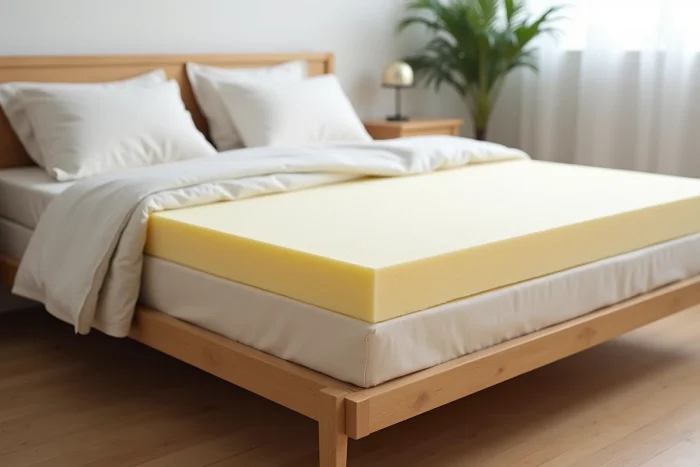
An electric bed modifies the sleeping geometry several times a night. The accompanying mattress must therefore bend, return to its original shape, and start again, without losing support or comfort. Latex, thanks to its honeycomb structure, has a natural elasticity that makes it particularly suitable for these repeated mechanical constraints.
Resistance to repeated bending: what the motor of the bed base demands from the mattress
When an electric bed raises the backrest or legs, the mattress undergoes localized deformation. A material that is too rigid forces the motor to work harder. ADEME reminds us in its 2024 guide on energy management in housing that electric beds are classified among the equipment for which consumption increases if the motor works against an unsuitable mattress.
Latex, especially in high-density natural form, offers well-calibrated resistance to bending. It bends without excessive friction against the slats or supports of the bed base, then returns to its original position without residual deformation. This mechanical behavior reduces the strain on the motor and extends its lifespan.
A pocket spring mattress, by comparison, does not follow the curves imposed by the lifting. The springs create blocking points that prevent the mattress from forming a regular arc.
Memory foam adapts to bending but recovers its shape more slowly, which can hinder frequent position changes during the night. To better understand the advantages of the gamma mattress on La Santé de Demain, this difference in mechanical behavior between materials is the starting point.

Density and comfort zones of latex on relaxation bed base
The density of a latex mattress intended for an electric bed is generally well above that of standard polyurethane foams. This high density explains two complementary properties: firm support of the spine and gradual comfort on the surface.
The honeycomb structure of latex creates differentiated support zones. Manufacturers perforate the block of latex with holes of varying diameters according to the zones (shoulders, hips, feet). On an electric bed base, this zoning retains its effectiveness even when the mattress is bent, as the cells compress and expand without losing their geometry.
Natural latex or synthetic latex on electric bed
Natural latex comes from rubber tree sap. Synthetic latex is derived from petroleum. Both bend properly on a liftable bed base, but their behaviors differ over time.
- Natural latex retains its elasticity longer because its molecular structure better withstands the mechanical fatigue of repeated bending
- Synthetic latex tends to compress more in the bending areas after a few years of intensive use on an electric bed base
- A blend of the two (often predominantly synthetic) offers a price compromise, but the bending zone remains the weak point to watch
Since 2023, several manufacturers display the GOLS certification for organic latex and the OEKO-TEX Standard 100 certification for chemical emissions. Some product sheets, particularly from Kipli or Latexco, now explicitly specify compatibility with electric bed bases in their certified documents.
Ventilation and hygiene of latex in raised position
An electric bed spends part of the night in an inclined position. This inclination alters the airflow around the mattress and inside it.
The cells of latex form a network of channels that ventilate the mattress from the inside. Air circulates through the perforations even when the mattress is bent, which limits moisture accumulation in the bending area. On a memory foam mattress, the closed cell structure retains more heat and moisture, a disadvantage amplified by the lifting that creates folds where sweat stagnates.
Natural latex also has intrinsic antifungal and antibacterial properties. For individuals using an electric bed due to gastric reflux issues or circulatory disorders, and who therefore spend more time in a semi-sitting position, this resistance to dust mites and mold represents a concrete long-term advantage.
Thickness and weight of the latex mattress: technical constraints to check
Not all latex mattresses are suitable for all electric bed bases. Two technical parameters determine real compatibility.
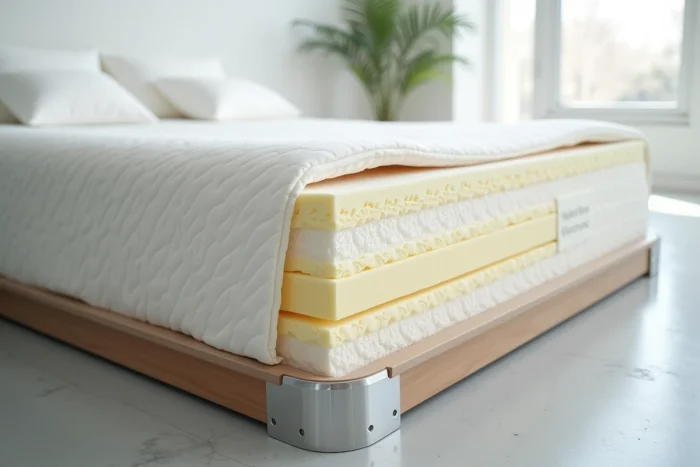
First, the thickness. A mattress that is too thick mechanically resists bending, even if the material is soft. Most electric bed base manufacturers recommend a maximum thickness to ensure smooth lifting operation. A latex that is too thick negates the advantage of its natural softness.
Next, the weight. Latex is significantly heavier than polyurethane foam at equal volume. This extra weight puts more strain on the joints of the bed base and the motor. On an entry-level bed base whose motor is sized to the minimum, a dense natural latex mattress can cause sluggish operation or even premature breakdowns.
- Check the maximum load indicated by the bed base manufacturer before choosing high-density latex
- Prefer a latex of moderate thickness rather than a very thick model that limits bending
- On a slatted bed base, latex adapts better than springs because the supports individually follow the deformation of the mattress
Slatted bed base or support bed base: what impact on latex
Electric slatted bed bases offer regular bending and are well suited to standard latex. Support bed bases, newer, allow multidirectional adaptation that fully exploits the three-dimensional elasticity of latex. Natural latex, more responsive, benefits more from a support bed base than synthetic latex.
The choice of a latex mattress for an electric bed relies on a balance between softness, density, and thickness. A certified natural latex, with thickness suitable for the bed base, reduces the load on the motor, ventilates better in the raised position, and retains its supportive properties despite daily bending. The point of caution remains the weight: it must be compared to the specifications of the bed base before any purchase.