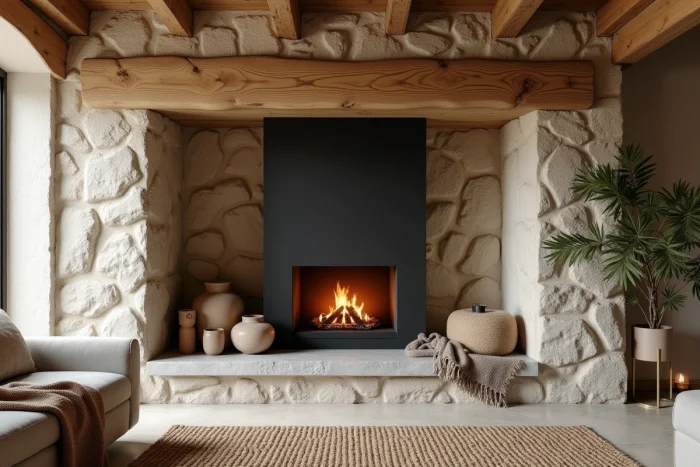
A rough stone cantou that darkens under soot, a massive hood that consumes the light of the living room, a flue whose functionality is uncertain: this is often where we start when deciding to modernize a cantou. The good news is that this architectural niche typical of old houses in the Massif Central, Lot, or Corrèze lends itself remarkably well to contemporary transformation, provided that the nature of the original materials is respected.
Breathable materials and constraints of old buildings in a cantou
Before thinking about decor, we address the problem that artisans specializing in the restoration of old buildings most often highlight: moisture and cracking due to non-breathable materials. Covering a cantou with drywall or standard Portland cement without prior treatment blocks the migration of water vapor in the masonry. Joints crack, plaster blisters, and we start over two years later.
The solution that has consensus among heritage professionals is the use of breathable materials: lime plaster, natural hydraulic lime mortar, wash. These products allow the wall to breathe while providing a smooth or slightly textured finish depending on the chosen option. Here, we find tips for a modern cantou that combine technical performance with a clean aesthetic.
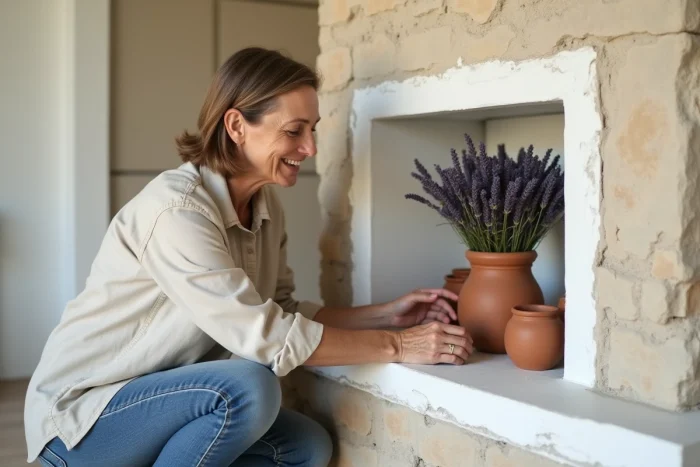
For exposed stone, a simple brushing followed by a mineral water-repellent treatment (no film-forming resin) is often enough to restore character without betraying the material. Feedback varies on this point depending on the condition of the stone, but the principle remains the same: we do not seal an old wall under a waterproof layer.
Transforming the cantou into a multi-use corner: stove, bench, and wood storage
The rise in energy costs since 2022-2023 has accelerated a trend that renovation companies observe on the ground: the transformation of cantous into multi-use corners. We no longer settle for lighting a fire occasionally. We want a functional space that justifies the square meters it occupies in the living room.
Integrating a wood or pellet stove
Replacing the open hearth with a high-performance stove is the first logical reflex. A wood or pellet stove connected to the existing flue (after lining) offers significantly higher efficiency than an open fire. The cantou niche accommodates the appliance and creates a natural framing that highlights the stove as a centerpiece of the living room.
The stove is sized according to the volume to be heated, not the size of the cantou. An overly powerful appliance in a well-insulated house can cause uncomfortable overheating.
Built-in bench and integrated storage
The depth of a cantou often allows for the installation of a built-in bench on either side of the stove. Some artisans offer heated benches connected to the flue system, which radiate heat long after the fire has gone out. It becomes a true reading nook, or even a workspace in winter.
For wood storage, low niches are built under the bench or on one side of the cantou. Closed storage prevents dust and insects associated with log storage in the living area.
- Lining the existing flue to connect a high-performance wood or pellet stove
- Built-in bench (possibly heated) to utilize the depth of the cantou
- Integrated storage niches for wood, closed with discreet hatches or doors
- Indirect LED lighting in the hood for comfortable use without a fire (reading, relaxation)
Cantou decor: the rustic japandi style
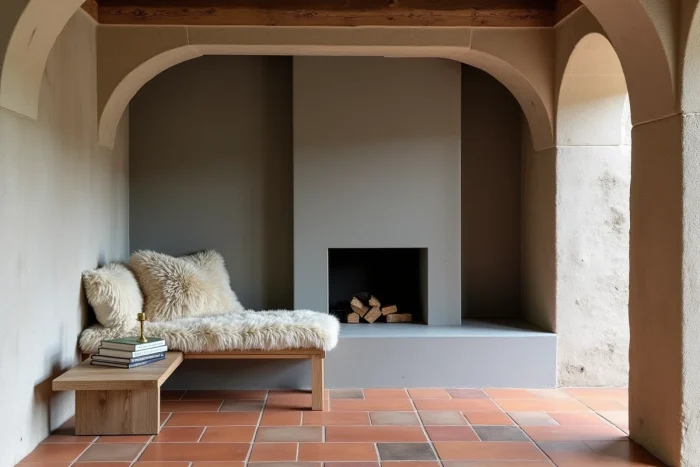
We are seeing a recent trend in renovation projects that works particularly well with the cantou: rustic japandi, which blends regional heritage and minimalism. The principle is simple. We keep the raw architectural element (the stone, the hood, the lintel beam) and simplify everything else.
In practical terms, this results in a very light lime plaster on the interior walls of the niche, a raw wood bench, and a single large piece of pottery placed in the hearth during the off-season. No accumulation of objects, no hanging copper, no decorative pot racks.
This approach works best in open living spaces where the cantou serves as a focal point. The color palette remains subdued: off-white, greige, light natural wood. We break the monotony with a unique textile (a thick linen cushion on the bench, for example) rather than a multitude of accessories.
Modernized cantou and property value in rural areas
A detail that can influence the decision to renovate: real estate agencies in rural areas (Lozère, Corrèze, Aveyron) now use the restored cantou as an explicit selling point in their listings. What was presented a few years ago as a “rustic fireplace needing refreshment” has become a heritage asset highlighted right from the main photos.
This does not mean that a modernized cantou mechanically increases the selling price. However, it reduces the time to market for an old house by making the property immediately livable and visually attractive to urban buyers seeking authenticity.
- Photograph the cantou with careful lighting for online listings
- Highlight the high-performance stove as the main heating equipment
- Emphasize the recovered living space thanks to the multi-use layout
A well-renovated cantou transforms the living space of an old house without erasing its identity. The choice of breathable materials determines the durability of the entire operation, and the rest (stove, bench, decor) builds upon this healthy technical foundation. It is better to have a well-prepared project in this regard than a superficial makeover that needs to be redone in three winters.