
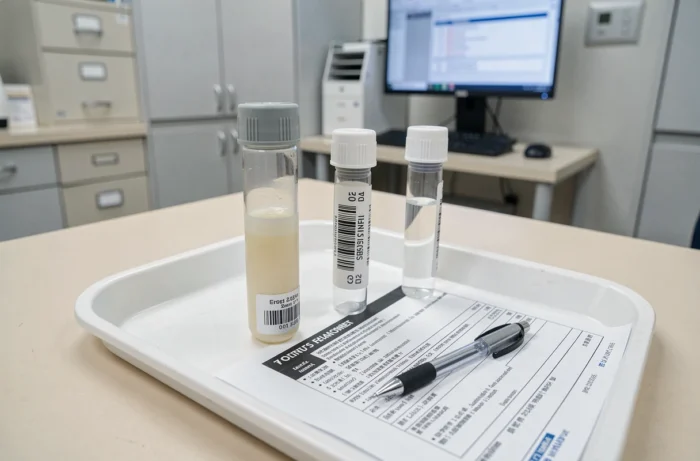
A lipid profile is received, and the first line mentions “opalescent serum.” Even before the cholesterol or triglyceride numbers, this simple mention triggers concern. In most cases, opalescent serum after a fatty meal indicates a massive presence of lipid particles in the blood, not necessarily a pathology.
Understanding what is happening in the test tube helps to differentiate between a dietary artifact and a real metabolic signal.
Postprandial lipemia and interferences with blood tests
When a hearty meal is consumed, the small intestine releases chylomicrons loaded with triglycerides into the circulation. These particles are so large that they scatter light, giving the serum its milky appearance noted as “opalescent” by the laboratory.
The real underlying issue is that lipemia disrupts several biological tests beyond just the lipid profile. The photometric methods used routinely measure light absorption through the serum. Turbid serum skews this measurement, and the results of certain parameters (liver enzymes, electrolytes, bilirubin) can be affected.
Modern analyzers detect lipemia and sometimes apply corrections, but these corrections have their limits. Beyond a certain turbidity threshold, the laboratory prefers not to report certain results and requests a new sample. This makes the meaning of slightly opalescent serum clearer when one realizes that the reliability of the entire profile may be compromised.
Non-fasting lipid profile: what current recommendations allow
For a long time, strict fasting was required before any lipid exploration. Practices are evolving. A non-fasting sample is still usable for routine cardiovascular screening, because total cholesterol, HDL, and non-HDL cholesterol vary little after a meal. It is mainly the triglyceride level that rises significantly.
The problem arises when calculating LDL cholesterol. The Friedewald formula, still widely used, loses accuracy when triglycerides are high. Two options then exist for the clinician:
- Request a new fasting sample to recalculate LDL under reliable conditions
- Use non-HDL cholesterol as a substitute marker, as it does not require fasting and includes all atherogenic lipoproteins
- Resort to the Sampson-NIH equation, which according to Ontario Health remains usable whether fasting or not as long as the triglyceride concentration does not exceed a certain threshold (beyond which LDL should not be reported by this method)
Non-HDL cholesterol is a reliable indicator even without fasting, and more and more scientific societies recommend it as a first-line assessment for cardiovascular risk.
Opalescent serum while fasting: causes not to be overlooked
Cloudy serum after a raclette is predictable. Opalescent serum from a sample taken after fasting for more than twelve hours is another situation. We then shift from a dietary artifact to a possible metabolic dysfunction.
Severe hypertriglyceridemia and risk of pancreatitis
When triglycerides remain very high despite fasting, the risk of acute pancreatitis becomes a concrete concern. Persistent fasting hypertriglyceridemia necessitates a search for secondary causes: poorly controlled diabetes, untreated hypothyroidism, excessive alcohol consumption, or certain medications (corticosteroids, retinoids, some antipsychotics).
In rare cases, the anomaly points to a genetic origin of hypertriglyceridemia, such as familial chylomicronemia syndrome. This diagnosis remains uncommon, but it radically changes management.

Distinguising transient lipemia from established dyslipidemia
In practice, the approach is simple: a fasting sample is redone. If the serum becomes clear again, the cause was dietary. If opalescence persists, the doctor directs towards a more thorough assessment, possibly including apolipoprotein testing and exploration of secondary causes.
Feedback varies on the duration of fasting necessary to “normalize” the serum. Generally, between eight and twelve hours is recommended, but some people metabolize dietary fats more slowly, especially in cases of overweight or insulin resistance.
High triglycerides and overall lipid profile: reading beyond cloudy serum
Focusing on the opalescent appearance of the serum is superficial. What matters for cardiovascular risk is the entire lipid profile: the ratio of HDL to LDL cholesterol, the fasting triglyceride level, and especially non-HDL cholesterol.
A clear serum does not guarantee a reassuring lipid profile. One can have perfectly clear serum with LDL cholesterol well above recommended thresholds. Conversely, a transient opalescent serum after a festive meal does not imply any treatment.
What triggers management is the repetition. A disturbed lipid profile over several successive samples, taken correctly, leads to hygienic-dietary measures or medication treatment. The doctor then assesses overall cardiovascular risk, taking into account factors such as age, smoking, hypertension, and family history.
- Isolated opalescent serum after a fatty meal: no worries, redo the fasting sample if results are necessary
- Opalescent serum while fasting: investigate hypertriglyceridemia and its causes (metabolic, medication-related, genetic)
- Clear serum with high LDL: do not be reassured by the appearance of the tube, cardiovascular risk remains present
The appearance of the serum is a useful visual indicator, but it does not replace a complete reading of the profile. A milky tube after a Savoyard fondue mainly tells you what you ate the day before. A milky tube while fasting reveals what your metabolism cannot eliminate, and it is this distinction that guides the next steps.