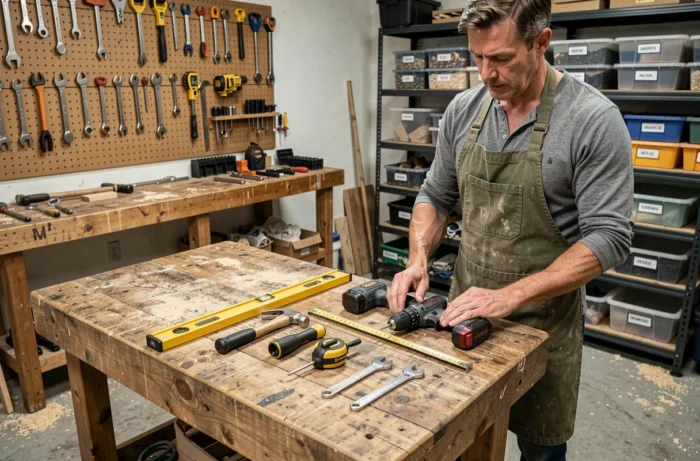
Building a coherent toolbox requires sorting the useful from the superfluous. The market offers hundreds of references, but about ten tools cover the vast majority of domestic tasks: fastening, cutting, measuring, adjusting. This classification moves from the most versatile tools to those that complement the equipment for more targeted jobs. A criterion often overlooked also guides the selection: the reparability of electric tools, which has become a concrete purchasing factor since the expansion of the reparability index in France.
1. Cordless drill-driver
This is the tool that is involved in the most projects. Drilling a wall for a plug, assembling a flat-pack piece of furniture, fixing a curtain rod: the cordless drill-driver replaces several manual tools on its own. The motor torque and variable speed allow for power adjustment according to the material.
When choosing, the battery voltage determines the drilling capacity. For common domestic use, a battery of intermediate voltage is more than sufficient. Also, check that the chuck accepts drill bits of various diameters, which avoids having to buy a second device for larger drilling tasks.
In terms of durability, some models now display a reparability index that assesses the availability of spare parts and ease of disassembly. Prioritizing a device that is well-rated on this criterion ensures that you can replace a battery or a switch without having to buy the entire machine again.
2. Set of flat and Phillips screwdrivers
A good set of screwdrivers is useful where the drill-driver would be too bulky or too powerful. Adjusting an electrical outlet, tightening a door handle screw, disassembling a device: the precision of manual handling remains irreplaceable for these tasks.
To cover the essentials on Univers du Bricolage, a kit of six to eight screwdrivers (three flat, three Phillips, one or two Torx) provides a solid foundation. Prefer ergonomic handles with a non-slip coating: the comfort of grip reduces fatigue and limits the risk of slipping on the screw.
3. Five-meter tape measure
No cutting or installation is done correctly without prior measurement. The five-meter tape measure covers almost all domestic needs, from measuring a room to checking a fixing center distance.
A tape measure with a wide blade and locking brake makes solo measurements easier. The end hook should slide slightly to compensate for its thickness, whether measuring from the end or hooking it. This detail, often misunderstood, is the primary source of measurement error among occasional DIYers.

4. Spirit level
Installing a shelf straight or checking the plumb of a frame requires a reliable spirit level. A model of forty centimeters offers a good compromise between precision and maneuverability. Levels with three vials (horizontal, vertical, 45 degrees) cover most configurations.
Laser levels exist, but for domestic use, the classic spirit level remains quicker to deploy and does not depend on any batteries. Its reliability does not degrade over time if the body is made of rigid aluminum.
5. Carpenter’s hammer
The carpenter’s hammer (about 300 to 500 grams depending on the models) is used for driving nails, adjusting joints, and removing plugs. Its integrated claw avoids the need to search for a second tool when a nail goes in crooked.
The fiberglass handle absorbs vibrations better than a traditional wooden handle. For regular work, this difference is noticeable on the wrists after half an hour of use.
6. Adjustable pliers
The adjustable pliers grasp, hold, and turn pieces of varying diameters: nuts, pipes, plumbing fittings. Its adjustable jaw makes it more versatile than a wrench for common tasks.
The push-button adjustment mechanism (like pump pliers) allows for quick one-handed adjustment. This system has largely replaced traditional rack-and-pinion designs on recent models. Choose a model whose jaws maintain their parallelism at each notch, a sign of careful manufacturing.
7. Universal tooth saw
For occasional cuts of wood, baseboards, or battens, the universal tooth saw remains the most accessible tool. A universal tooth cuts equally well when pushing or pulling, which is suitable for DIYers who have not yet mastered the regular motion of an experienced sawyer.
The ideal blade length is around forty-five centimeters for general use. Below that, long cuts become laborious. Above that, the saw loses maneuverability in tight spaces.
8. Snap-off utility knife
Opening a box, cutting wallpaper, adjusting a silicone joint: the utility knife is involved in dozens of micro-tasks. The snap-off blade renews itself segment by segment, maintaining a sharp edge without complete replacement.
Models with automatic locking prevent the blade from retracting under pressure. This is a safety feature not to be overlooked, especially when making forceful cuts in thick cardboard or soft flooring.
9. Orbital sander
Preparing a piece of furniture before painting, smoothing a filler, stripping a shutter: the orbital sander significantly speeds up these finishing tasks. It accepts abrasives of different grits, from coarse grit for stripping to fine grit for smoothing.
- Coarse grit (40-80): stripping chipped paint or old varnish from raw wood
- Medium grit (120): surface preparation before undercoat or paint
- Fine grit (180-240): final smoothing between two coats of paint or varnish
Before purchasing, check if the model offers a built-in dust extraction system or a connection for a vacuum cleaner. Sanding generates a significant amount of fine dust, and working without extraction in a confined space poses a real comfort and health issue.
10. Tool box with modular storage
The last item in the ranking is not a tool in the strict sense, but it conditions the efficiency of all the others. A well-compartmentalized toolbox prevents wasting time searching for the right socket or drill bit at the bottom of a drawer.
- Removable compartments to separate screws, plugs, and small parts
- Top tray for the most frequently used tools (screwdrivers, utility knife, tape measure)
- Reinforced bottom to support the weight of the hammer and adjustable pliers without deforming
Putting each tool back in its place after use may seem trivial, but it is the only habit that guarantees a functional workshop for the next project. DIYers who accumulate tools in a jumble often end up buying ones they already own.
The equipment described here covers fastening, measuring, cutting, and finishing. For electric tools like the drill-driver or sander, the reparability index is now a concrete selection criterion in France, as it provides information on the availability of parts and ease of maintenance over time. Starting with these ten references and adding to them over time remains the most economical strategy.