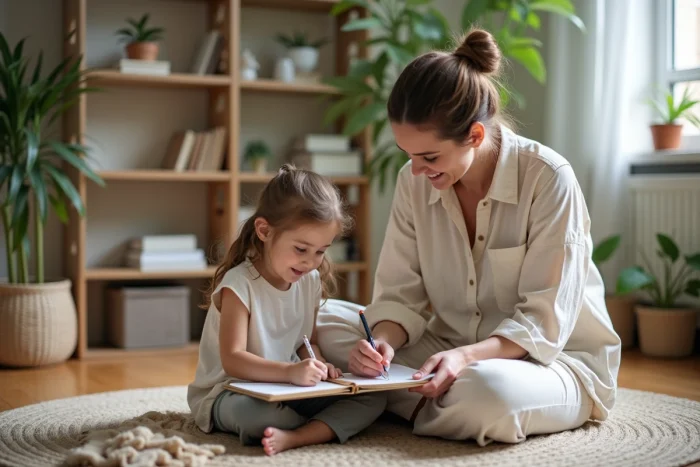
Parenting today encompasses contradictory expectations. Recent studies show that parents’ mental health, their stress levels, and their mental load weigh as heavily on child development as the educational methods themselves.
In France, the National Strategy for Supporting Parenthood 2023-2030 acknowledges this shift in perspective by speaking of “co-education” and the right to support for all parents.
Parents’ Mental Health and Children’s Education: An Underestimated Link
A 2023 meta-analysis of over 120 studies highlighted a finding that shifts the paradigm: programs combining educational advice and support for parental mental health produce more lasting effects on children’s behavior and academic success than those focused solely on techniques to apply with the child. The post-pandemic context has made this data more visible, as parental stress has significantly increased during and after lockdowns.
This observation compels us to reconsider how we talk about positive education or gentle parenting. An exhausted, anxious, or isolated parent gains only limited benefit from a list of “best practices.” The resources offered on https://www.parents-en-action.com/ align with this holistic support approach, where the parent’s well-being is part of the educational equation.
Field feedback diverges on this point: some early childhood professionals believe that parents do not need psychological support to educate properly, while available data suggests that reducing parental stress directly improves the quality of interactions with the child.
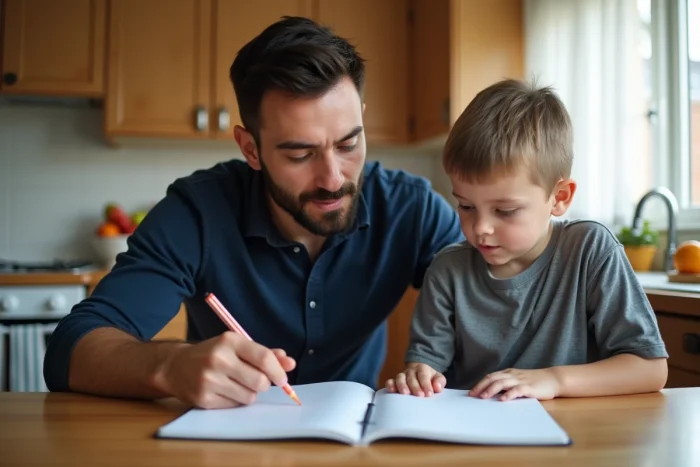
Parental Technoférence: When Adults’ Screens Disrupt Learning
The debate about screens almost always concerns the time children spend in front of a tablet or phone. A longitudinal study conducted in four European countries provides a different perspective: intensive smartphone use by parents (a phenomenon called “technoférence”) is associated with more conflicts in the parent-child relationship.
The mechanism is quite direct. A parent who checks their phone during a meal, a game, or a conversation interrupts the mutual attention loop that the child needs to develop their social and emotional skills. This is not a moral issue but a matter of cognitive availability.
Limiting one’s own screen exposure in the presence of the child is a concrete lever, easier to implement than a structured educational program. A few guidelines help frame this approach:
- Define specific phone-free time slots during shared moments (meals, school-home trips, bedtime), rather than a vague overall goal of “less screen time.”
- Physically place the phone out of reach during these times, as the mere visible presence of the device reduces the quality of attention according to several studies in cognitive psychology.
- Observe one’s own habits for a week before changing anything, to identify the moments when interruptions are most frequent.
Co-education and Support for Parenthood: What the National Strategy 2023-2030 Changes
The National Strategy for Supporting Parenthood 2023-2030 introduces vocabulary and objectives that contrast with previous approaches. The term co-education gradually replaces “parental assistance,” signaling that schools, communities, and families share responsibility for child development.
Among the explicit objectives of this strategy is the increased use of parent-child welcoming spaces and family mediation services, particularly in priority neighborhoods. This territorial dimension is rarely highlighted in mainstream content, even though it conditions real access to resources.
What This Means for Parents in Daily Life
A parent seeking support no longer has to turn solely to books or social media accounts. Local structures (family houses, social centers, PMI) are expected to offer spaces for dialogue and peer exchange, not just individual consultations.
The available data does not yet allow for measuring the effect of this strategy on the ground. The deployment remains uneven across territories, and the gap between stated objectives and allocated resources is subject to criticism from parenting support associations.

Positive Discipline and Emotional Skills Development at Home
Positive discipline is based on a principle that holds up well under data scrutiny: replacing punishment with the learning of self-discipline reduces problematic behaviors without generating the side effects of coercive methods (anxiety, aggression, breakdown of trust).
In practice, this approach requires the parent to name the child’s emotions, set clear boundaries without resorting to shouting or physical punishment, and value expected behaviors rather than sanction deviations. The theoretical framework is solid. The challenge lies in daily application, especially when the parent is tired or under pressure.
- Start with just one moment of the day (bedtime, for example) to experiment with rephrasing rather than instructing, before generalizing.
- Accept that the child goes through intense emotions without trying to suppress them: anger or frustration are part of social and emotional learning.
- Revisit a conflict once calm is restored, describing the facts without judgment, to help the child build their own analytical capacity.
The development of emotional skills is not limited to the home. Consistency between the family environment and that of school or daycare reinforces learning. Teachers who know the educational practices used at home can adapt their approach, and vice versa.
Supporting a child in their education is not just about applying a method. Recent studies all point in the same direction: the parent’s well-being conditions the quality of the educational environment. The question is no longer just “what to do with my child,” but “what do I need to be able to do it.”