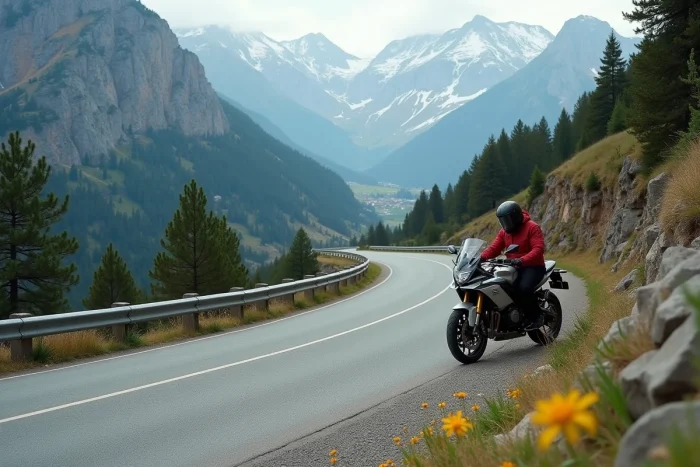
The N-260 connects Portbou, at the French border on the Mediterranean, to the vicinity of Sabiñánigo in the province of Huesca. This Spanish national road traverses the entire southern slope of the Pyrenees along an east-west axis. We consider it one of the most comprehensive routes to appreciate the geological and climatic diversity of the mountain range, far beyond its image as a picturesque motorcycle road.
Road Profile and Recent Developments of the N-260 Segments
The N-260 is not uniform. Its eastern part, between Figueres and Besalu then towards Olot, has undergone significant works since 2022: overtaking lanes, straightening of tight turns, new roundabouts. The Ministerio de Transportes y Movilidad Sostenible has published several project sheets detailing these improvements between 2022 and 2024.
These modifications change the game for those preparing a N260 route itinerary in Spain based on accounts from a few years ago. Travel time on this segment has decreased, and the coexistence between slow vehicles (vans, motorhomes) and fast two-wheelers has improved.
The section between Figueres and Olot is no longer the bottleneck described in older guides. We recommend not bypassing it via the highway, as the volcanic landscapes of the Garrotxa alone justify the detour.
The central part, in the provinces of Lleida and Huesca, retains its mountainous character: narrow roadway, winding turns, absence of emergency lanes. It is the technical heart of the route.
Speed Cameras and Variable Speed Limits on the N-260 in the Mountains
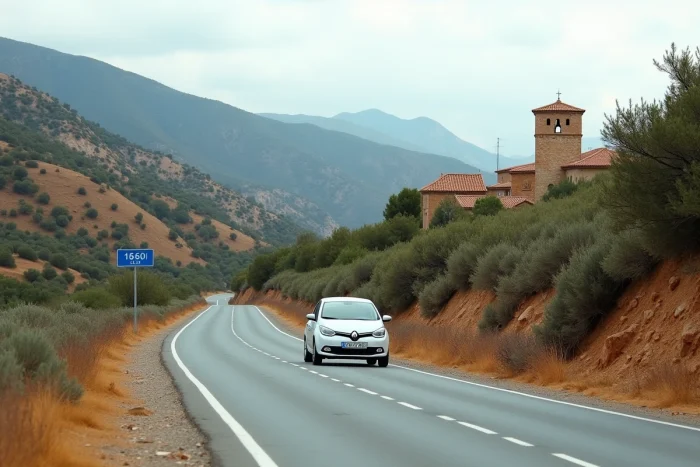
Many road-trippers are unaware: the DGT (Dirección General de Tráfico) installed fixed speed cameras and variable speed limit signs on several accident-prone sections between 2021 and 2024, particularly in the provinces of Huesca and Lleida. These devices explicitly target motorcycles and recreational vehicles.
The DGT’s “Rutas seguras para motoristas” campaigns accompany these installations. The speed camera maps are regularly updated on the official DGT website, and we advise checking them before departure.
- Variable speed limit zones focus on mountain passes and winding descents, where the allowed speed can drop from 90 to 60 km/h depending on weather conditions.
- Controls are intensified on weekends and during holidays, periods of high motorcycle traffic on this route.
- Fines for speeding in Spain are payable on the spot for non-residents, with a discount if payment is made within twenty days.
Driving on the N-260 as if it were an unmonitored mountain road is a mistake. The historical accident rate of certain turns has led authorities to tighten surveillance.
Aínsa-Sort Section: The Most Challenging Passage of the Spanish Pyrenees
Between Aínsa (Huesca) and Sort (Lleida), the N-260 crosses the Congost de Collegats, a limestone gorge where the road winds between vertical walls. This passage is the most spectacular of the route, but also the most demanding.
The roadway is sometimes reduced to a single lane with alternating traffic. The maximum height for large vehicles is constrained by the rock. Vans longer than six meters must anticipate tricky crossings.
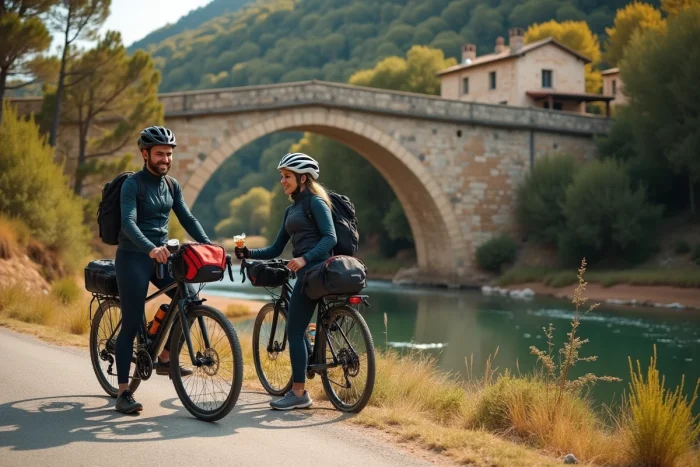
The village of Aínsa, ranked among the most beautiful in Spain, is a logical stop before tackling this segment. Its medieval plaza Mayor and 11th-century Romanesque church deserve a prolonged visit. Beyond Collegats, the valley opens up towards the Noguera Pallaresa, a river popular for white-water sports.
Fuel Management on This Segment
Gas stations are scarce between Aínsa and Sort. We regularly observe vehicles running out of fuel on this segment, particularly motorcycles with limited tanks. Refueling in Aínsa or Campo before entering the gorges eliminates this risk.
Crossing the Cerdagne and Descending Towards Cap de Creus
The N-260 passes through Puigcerda, a border town with Bourg-Madame on the French side. This area of Cerdagne offers a high plateau contrasting with the previous gorges: open landscapes, meadows, and clear views of the Cadi massif.
From Puigcerda, the road descends towards the plain of Emporda passing through Figueres. The climatic transition is abrupt: in just a few dozen kilometers, one goes from a mountainous environment to Mediterranean warmth.
The eastern end of the N-260, between Figueres and Portbou, runs along the foothills of the Albères. This less famous segment provides access to Cap de Creus and the villages of Colera and Llança, where accommodations are available at much more reasonable rates than on the nearby Costa Brava.
Connecting with the Secondary Road Network
The N-260 only makes sense when combined with the roads that cross it perpendicularly, heading north-south. The routes leading to the Bielsa tunnel (towards France), the Portalet pass, or the Val d’Aran transform a simple east-west journey into a complete Pyrenean loop.
- The A-138 connects to the Bielsa tunnel and allows a return to France via the Aure valley.
- The C-28 climbs the Val d’Aran to Vielha, a crossing point to Bagnères-de-Luchon.
- The N-230 links the central segment of the N-260 to the Lleida plain and the highway to Barcelona.
The N-260 acts as a backbone to which north-south routes are attached. Planning a star-shaped road trip, with incursions into France or southern Aragon, fully exploits the potential of this axis.
The best time to travel the entire N-260 is from May to October. The passes in the central segment may be snow-covered or icy out of season, and some portions do not have systematic winter treatment. Leaving early in the morning helps avoid the convoys of motorhomes that saturate the overtaking lanes from mid-morning.