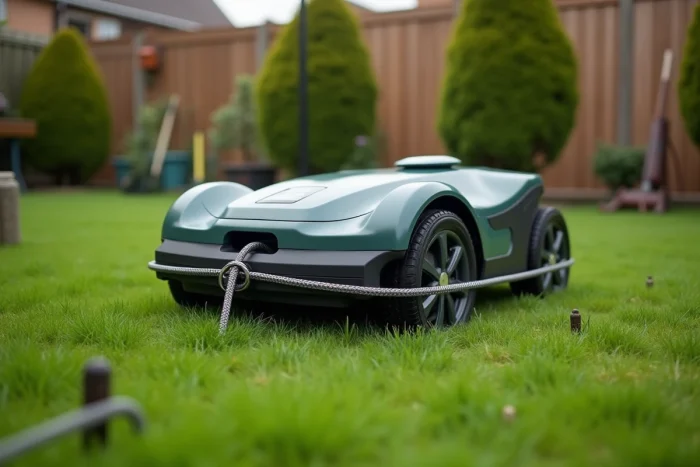
A lawn mower robot left on its charging station in the middle of the night, in a garden open to the street, represents an easy target. The equipment is expensive, sells quickly, and a thief only needs a few seconds to lift it and disappear. Before multiplying gadgets, it’s wise to understand what truly makes theft difficult and what is merely a matter of publicity.
The charging station, the first weak point to secure
We first think of the robot itself, but the charging station is a target in its own right. A thief who retrieves the station can put a stolen robot back into service or facilitate its resale. Several manufacturers and insurers confirm this in their protection guides.
Anchoring the station to the ground with screws suitable for the surface (concrete, slab, compacted earth) already complicates the operation. Even better, it can be installed in a dedicated shelter or a discreet corner of the garden, out of direct view from the street or a pathway. When choosing to protect your lawn mower robot against theft, starting by making the station invisible and securely fixed changes the game.
A detail often overlooked: the power supply cable of the station. If it is visible and easily disconnectable, simply pulling it can neutralize the entire system. It’s advisable to bury this cable or run it through a conduit fixed to the wall.
Software locking and owner account: what really blocks resale
Mechanical protections slow down theft. Software protections make it pointless. The trend among manufacturers is towards a locking of the robot linked to the owner account: without the owner’s credentials, the robot becomes an unusable object, even after a reset.
This principle works like the activation lock on a smartphone. A stolen but locked robot has no resale value for an informed buyer. Not all models yet offer this level of security, but it’s a criterion to check before purchase.
PIN code and sound alarm: the basics, not the solution
Most recent models include a PIN code that locks the device if someone tries to use it. It’s a first filter, but a thief who takes the robot in a car trunk won’t be stopped by a PIN code alone.
The sound alarm, triggered when the robot is lifted, mainly has an immediate deterrent effect. In a dense residential area, the noise can alert the neighborhood. In isolated areas, feedback on this point varies: the sound doesn’t always carry far enough to be useful.
These two functions should be activated systematically, but they do not replace the following layers of protection.
GPS and geofencing: locating a stolen robot and limiting its operating area
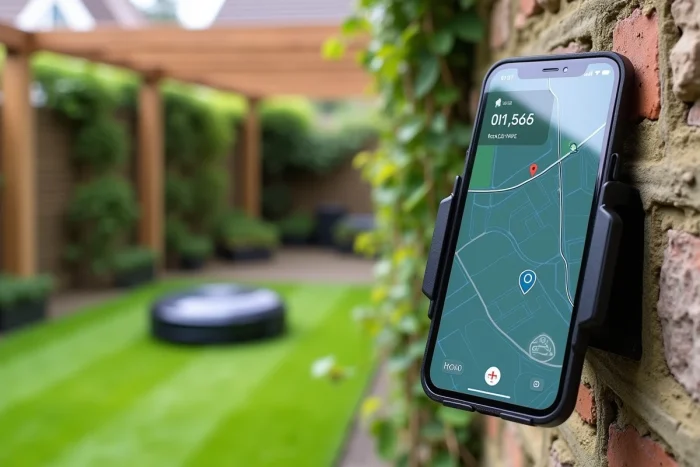
GPS tracking allows you to locate the robot in real-time via an app. In case of theft, you can relay the position to law enforcement. Several brands offer this feature, sometimes with an associated subscription.
Geofencing adds a logical barrier: you define a virtual perimeter around the garden, and if the robot exits it, an alert is sent to the owner’s phone. This is a relevant protection because it intervenes in real-time, even before the thief has left the neighborhood.
Elements to check before relying on GPS:
- The accuracy of the signal in your environment (gardens surrounded by tall buildings or dense vegetation may reduce reliability)
- The necessity of a subscription for continuous tracking (some manufacturers charge for this service after the first year)
- The compatibility with the manufacturer’s app, which centralizes alerts, position history, and remote locking
Physical measures and mowing habits to reduce exposure
Beyond the onboard technology, practical choices reduce risk. Scheduling mowing during the day rather than at night reduces the window of opportunity for discreet theft. A robot moving in a well-lit garden, potentially visible from windows, attracts fewer thieves than a silent robot on its station at 3 a.m.
Engraving and marking the robot
Engraving an identification number on the chassis or applying a visible marking complicates resale. A second-hand buyer who sees an engraved number knows that the device is traceable. This is not an absolute protection, but it is an additional deterrent that costs almost nothing.
What a home insurance policy covers
Checking your home insurance policy before investing in a lawn mower robot avoids unpleasant surprises. Some policies cover the theft of garden equipment, while others exclude items left outside without physical protection (closed shelter, garage).
Points to clarify with your insurer:
- Is the robot covered as garden equipment, or is a specific extension needed?
- Is theft without break-in (robot simply left outside) covered?
- Do you need to keep the purchase invoice and serial number for the claim to be valid?
A well-protected robot combines software locking, physical anchoring of the station, and adapted mowing habits. No single measure is sufficient. It is the accumulation of deterrents, from the PIN code to geofencing to engraving, that transforms your robot into a target too complicated for a hurried thief.