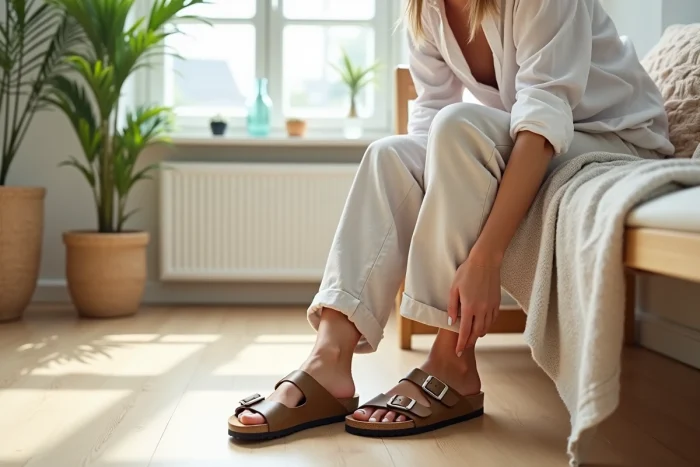
When you spend the day standing on tile, in a workshop or during consultations, the choice between Birkenstock and Scholl is not just a matter of looks. Both brands offer anatomical insoles, but their construction, materials, and performance after several months of use differ in concrete ways.
Cork sole vs molded sole: what changes in daily life
The Birkenstock sole is based on a core of cork and natural latex that gradually compresses to fit the shape of the foot. This breaking-in period usually takes one to two weeks, which can be uncomfortable at first. The arch support is pronounced, and the support is firm from the start.
At Scholl, the historical Pescura range uses a base made of wood or a more rigid molded material, while the current models incorporate memory foam. The comfort is immediate, but the support collapses faster on the foam versions, especially if worn daily on hard floors.
This distinction is also found in several reviews on Birkenstock or Scholl published by users who have tested both over time.
For flat feet or those with a low arch, the initial rigidity of Birkenstock can be problematic. The French Union for Foot Health reminds us that pre-formed anatomical insoles are not suitable for all foot profiles, and a specialized opinion is preferable in case of declared pathology.
Birkenstock Arizona vs Scholl Pescura: wear and durability in the field
The Arizona, Birkenstock’s best-selling model, is available in full-grain leather, Birko-Flor (synthetic), and now in a “Vegan” version. The EVA outsole holds up well against abrasion on asphalt and hard surfaces. After several seasons, the cork may crack if not maintained with an appropriate product, but the structure remains functional well beyond two years of regular use.
The Scholl Pescura, relaunched with a retro spirit since 2022-2023 with more fashionable finishes and updated colors, plays in a different league. The wooden base (or wood imitation depending on the series) does not handle prolonged moisture well. However, the leather strap ages properly if conditioned.
What we observe after six months of intensive use
- On Birkenstock, the cork compacts and retains the footprint of the foot, which improves support over time but makes the pair difficult to share
- On Scholl (foam range), the mattress loses its resilience and the heel sinks, creating an imbalance while walking
- On Scholl Pescura (wood base), the rigidity remains constant, but the straps wear at friction points, especially on single-strap models
Feedback varies on this point, as durability depends heavily on the person’s weight and the type of floor frequented.
Vegan range and alternative materials: where the two brands stand
Birkenstock has clearly taken the lead since 2023-2024 by expanding its “Vegan” collection to include the Arizona, Gizeh, and Madrid models. The “Vegan” label appears directly on product sheets and packaging, making it easier to choose in-store or online. Birko-Flor mimics the look of leather with a soft felt backing, and the sole remains the same as the leather versions.
Scholl does not communicate with the same clarity about its materials. Some models use synthetic materials without claiming them as ethical alternatives, while others retain leather without specifying its origin. For buyers filtering by vegan criteria, Birkenstock offers a more transparent purchasing experience.
Scholl in fashion, Birkenstock in permanent wardrobe: two distinct pricing positions
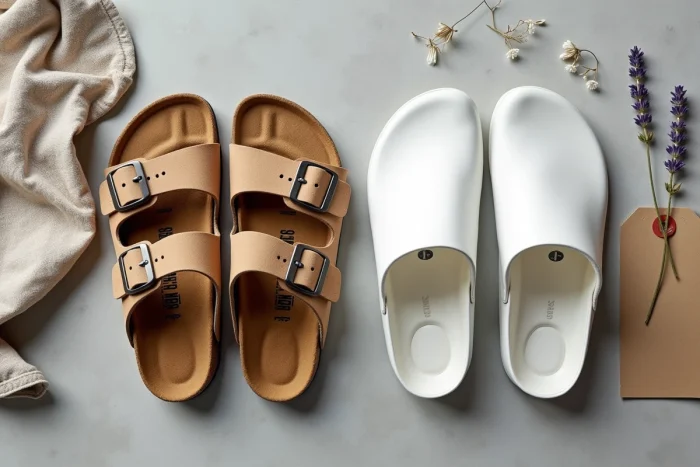
Birkenstock positions itself in the premium segment. The price of Arizona in leather exceeds that of most equivalent Scholl sandals. This difference is partly justified by the natural cork and by a manufacturing process that is still largely European.
Scholl targets a broader spectrum with accessible entry-level options (mules, slides) and fashionable pieces like the revamped Pescura, sold on trendy multi-brand platforms. The cost per wear remains more favorable with Birkenstock when considering three years of use, as the cork sole lasts longer than memory foam.
Selection criteria based on usage context
- Prolonged standing on hard floors (kitchen, lab, reception): Birkenstock, for arch support and cork durability
- Occasional summer use with a desire for stylistic variety: Scholl, thanks to a more diverse range of shapes (clogs, heeled mules, flat sandals)
- Looking for a clearly identified non-leather option: Birkenstock, with its marked vegan collection
- Tight budget for a first purchase of anatomical sandals: Scholl in entry-level, accepting a shorter lifespan
The choice between these two brands boils down to a simple criterion: frequency of wear. For a pair worn every day, the initial extra cost of Birkenstock pays off due to the longevity of the sole. To complement a wardrobe with several models worn in rotation, Scholl allows for style variation without inflating the bill.