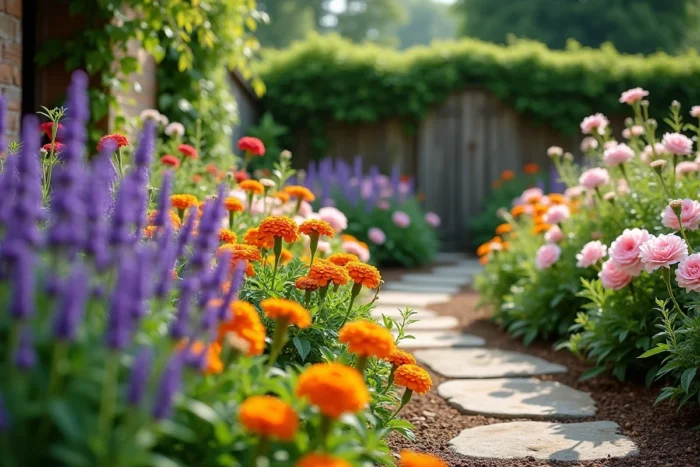
A flower bed that loses its colors by July, we’ve all experienced that. The problem rarely stems from a poor choice of varieties: it’s often a mismatch between the available soil, the actual exposure of the land, and the water needs of the planted flowers. Growing the most beautiful flowers for a colorful garden all season long requires reasoning through constraints before reasoning through desires.
Drought-resistant flowers: the first filter to apply
With the increasing number of prefectural orders restricting watering in many French departments over the past few years, planting water-hungry flowers is like betting against the weather. You save time and peace of mind by starting from a list of water-wise plants suitable for dry gardens.
The gaura, lantana, ornamental sages, zinnia ‘Profusion’, and rudbeckia hold up even when watering is limited. The French Office for Biodiversity and the Occitanie region have published guides “Gardening with Less Water” that list these species among the adaptation solutions to climate change for private gardens.
You can find other varieties suited to each situation by browsing the flowers on Info Jardinage, which categorizes species by type of exposure and soil.
The ornamental euphorbia also deserves attention. Its yellow-green or copper-orange hues bring an unusual touch of color to flower beds, and it withstands draining and poor soils without flinching. In a sunny, rocky terrain, it’s a safe bet.
Combining perennials and annuals for continuous blooming in the garden
A garden that remains colorful from spring to autumn is based on a simple principle: perennials provide structure, while annuals fill the gaps. Planting only annuals requires starting over every year. Planting only perennials leaves weeks without flowers between two blooming peaks.
The perennial base: flowers that return each year
Long-blooming perennials form the backbone of the flower bed. The ornamental sage blooms from early summer until the first frosts. The rudbeckia takes over in late summer with its large yellow-orange flowers that last several weeks.
For shaded areas, hellebores (Christmas roses) offer valuable winter blooms, starting in January in regions with mild climates. Naples cyclamen cover the autumn with pink and white hues without requiring watering.
Annuals to enhance color density
Zinnias, cosmos, and nasturtiums can be sown directly in the ground in spring. Their role is to fill the spaces between still-young perennials and provide bright colors (orange, red, pink) throughout the summer. They are reseeded each year, but the cost of seeds remains negligible compared to buying potted plants.
- Zinnia ‘Profusion’: compact, heat-resistant, continuous blooming until October. Ideal for borders or pots.
- Cosmos bipinnatus: grows quickly, tolerates poor soils, with white, pink, or purple flowers that attract butterflies.
- Nasturtium: effective ground cover, edible, and its bright orange hues warm up the beds from June.
Pollinator-friendly mixes: a colorful garden that supports pollinators
There is a clear increase in the planting of flower mixes labeled “pollinator-friendly” in private gardens in France. The Seasons Observatory and the National Museum of Natural History document this trend in their recent participatory science reports on urban biodiversity.
These mixes (often sold under the name “flower meadows” or “pollinator mixes”) combine annuals and perennials chosen to provide nectar and pollen for as long as possible. They include phacelias, cornflowers, crimson clovers, and poppies.
The practical advantage: a single sowing in spring, on a roughly prepared plot, and the mix manages itself almost entirely. No intensive weeding, no staking. Returns vary on the density of blooming in the first year, but by the second season, the perennials in the mix take over, and the result becomes more consistent.
Soil and exposure: adapting flower choices to your actual terrain
Before buying anything, we look at two things: the type of soil and the orientation of the flower bed. A clay soil that retains water is not suitable for the same flowers as a sandy soil that drains quickly.
- Clay and heavy soil: favor autumn asters, daylilies, and irises, which tolerate stagnant moisture.
- Sandy and draining soil: lavenders, gauras, and ornamental euphorbias thrive here, even without amendments.
- Limestone soil: peonies, scabious, and red valerian prosper naturally.
- Partial shade under deciduous trees: hellebores, forget-me-nots, and brunneras cover the ground with early spring blooms before the tree foliage completely shades them.
A well-identified soil prevents repeated planting failures. You can do a simple test by squeezing a handful of damp soil: if it forms a compact ball, it’s clay. If it crumbles immediately, it’s sandy.
Full sun or partial shade: two different color palettes
In full sun (south or southwest orientation), flowers must withstand heat and rapid evaporation. Sages, rudbeckias, and zinnias are made for that. In partial shade, we switch to softer shades with foxgloves, astilbes, and columbines.
The temptation to force a sun-loving plant into a shaded corner (or vice versa) produces leggy, poorly blooming plants that are vulnerable to diseases. It’s better to work with the existing exposure rather than against it.
A vibrant garden doesn’t necessarily require dozens of varieties. Three or four well-chosen species for the soil, exposure, and local climate, combined in complementary perennials and annuals, are enough to cover blooming from spring to autumn. The rest is just mulching to retain moisture and a quick trim of faded flowers to encourage new bud production.