
Observing the Eiffel Tower, the zinc roofs of the Marais, or the glass roof of the Grand Palais without leaving your couch is now possible thanks to aerial content available online. Aerial views of Paris offer a different perspective on the architecture of the capital, where each neighborhood reveals geometries invisible from the ground.
Reading Parisian architecture through its rooftops and layouts
Have you ever noticed that Haussmannian buildings all seem identical from the street? From the sky, it’s a different story. The inner courtyards, skylights, and hidden gardens create a patchwork that only a vertical view can capture.
The zinc roofs of Paris form an almost uniform gray blanket across an arrondissement. However, this homogeneity conceals variations: ridge height, orientation of dormers, shapes of chimneys. Every roofing detail tells a story of a construction era. A mansard roof in the 6th arrondissement does not have the same profile as a flat roof in the 13th.
Platforms that offer aerial photos and videos allow you to zoom in on these details. You can compare, from the house page of Paris seen from the plane, images taken at different altitudes to understand how the urban fabric is organized around the Seine, parks, and major thoroughfares.
The radial layouts starting from the Arc de Triomphe, for example, only make geometric sense from a bird’s-eye view. Twelve avenues radiate outward, and this figure is never guessed at human height.
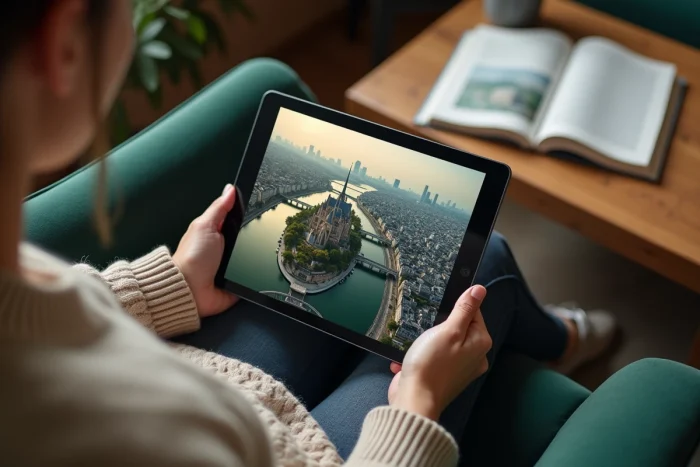
Monuments of Paris from an aerial view: what the ground does not show
Some monuments radically change personality when viewed from above. The Louvre is a good example. On the ground, one perceives a massive façade. From the sky, one discovers the Cour Napoléon, the glass pyramid, and the wings of the palace forming a perfect U.
The Grand Palais and the Petit Palais form a symmetrical duo visible only from an aerial view. Their glass roofs, domes, and the axis they share with the Alexandre III bridge create a composition that aerial photographers regularly capture. This type of content circulates on social media, but the high-resolution versions available on specialized sites offer a much higher level of detail.
Sacré-Coeur and Panthéon: two domes, two logics
The Sacré-Coeur, perched on the Montmartre hill, dominates the north of Paris. Viewed from the sky, its white dome contrasts with the dark roofs of the neighborhood. The Panthéon, on the other hand, is laid out in a Greek cross plan that aerial photography makes instantly readable.
Comparing these two domes from the sky helps to understand their architectural styles without opening an art history textbook. The Romano-Byzantine style of the Sacré-Coeur and the Neoclassical style of the Panthéon are immediately apparent when observing their mass plans.
Tools and formats to explore Paris from the sky from home
Looking at photos remains the simplest entry point. Websites specializing in aerial photography of Paris offer galleries categorized by neighborhood, monument, or theme. Some distinguish images based on the season or time of day, which profoundly alters shadows and colors.
Aerial video serves as a complementary format. It adds movement, transitions between monuments, and the perception of distances. A filmed flyover from the Louvre palace to La Défense allows one to grasp the historical perspective of the royal axis over several kilometers.
Here are the most common formats for discovering Paris from the sky from your home:
- High-resolution photo galleries, which allow zooming in on architectural details like the gargoyles of Notre-Dame or the ironwork of the Petit Palais
- Commented flyover videos, which combine aerial visuals with historical or heritage context for each monument
- 360-degree virtual tours, which offer the possibility to pivot around a point and choose your angle of view on the roofs and terraces of Paris
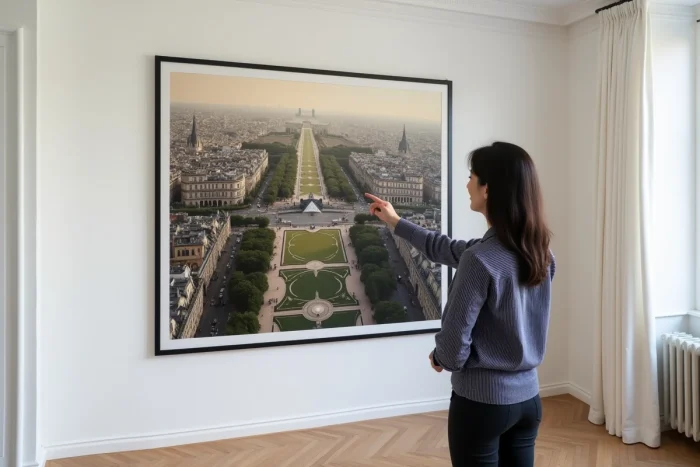
Season, light, and framing: what makes the difference in aerial photography of Paris
An aerial view of the Champ-de-Mars in July and the same view in December do not tell the same city. The low winter light elongates the shadows of the monuments and highlights the reliefs of the rooftops. In summer, the vegetation of the parks creates green patches that structure the map of the city.
The time of day also changes the game. Sunrise produces golden tones on the stone, while the end of the day tints the façades pink. The most sought-after aerial content exploits these variations to show Paris in several atmospheres.
Vertical or oblique framing: two different readings
Strictly vertical framing (like a map) highlights mass plans and geometries. It is the ideal format for understanding Parisian urbanism, star-shaped squares, or French gardens like the Tuileries.
Oblique framing, on the other hand, restores volumes. One perceives the height of the Saint-Jacques tower, the curvature of the Seine, or the depth of inner courtyards. Alternating these two framings provides a complete understanding of a neighborhood.
- Vertical view: perfect for gardens (Tuileries, Luxembourg), squares (Concorde, Vendôme), and urban layouts
- Oblique view: suitable for volumetric monuments (Eiffel Tower, Notre-Dame, Opéra Garnier) and perspectives along the Seine
- 360-degree panoramic view: useful for orienting oneself and situating monuments in relation to one another in the Parisian landscape
Exploring Paris from the sky is ultimately learning to read a city differently. The aerial content accessible online transforms each session into a form of guided tour, where architecture is understood through geometry before it is understood through history. The next zinc roof you spot in a photo might just inspire you to seek out what it hides beneath.