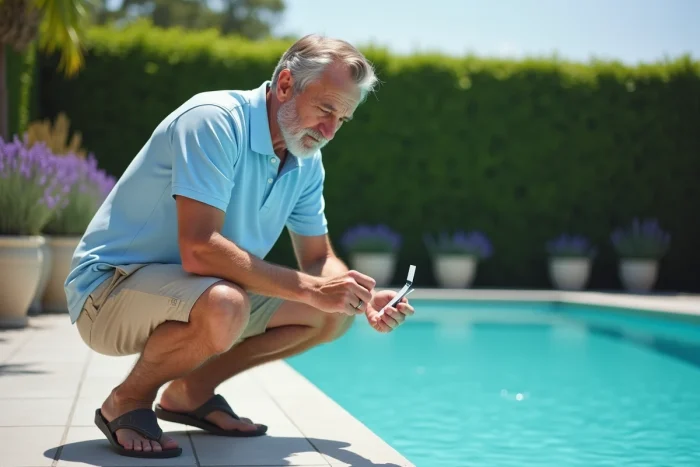
A TAC that exceeds the target range raises the pH, reduces chlorine efficiency, and promotes scaling of heat exchangers. Before touching any product, we recommend checking the source of the problem: hard filling water, overdosing of sodium bicarbonate, or lack of partial renewal for several seasons.
Relationship between TAC-pH-calcium: why correcting TAC in isolation does not work
Lowering the TAC without monitoring the pH and water hardness (TH) is akin to shifting the imbalance. TAC, pH, and TH form an inseparable triplet in the Taylor balance. Adding an acid to reduce alkalinity simultaneously lowers the pH, sometimes below 6.8, making the water corrosive to seals, metal parts, and the liner.
We regularly observe pools where the TAC has been brought back into the target range, but the TH remains above 400 ppm due to untreated well water. In this case, calcium carbonate precipitates despite a correct TAC, and scaling persists. Checking the TH before intervening on the TAC avoids this trap.
To learn how to reduce a high pool TAC without upsetting the balance, acid correction should be done in stages, monitoring the pH after each addition.
Sodium bisulfate or hydrochloric acid: choosing the right TAC pool corrector

The two most common acids for lowering a pool’s alkalinity are sodium bisulfate (pH Minus in powder) and diluted hydrochloric acid. Their modes of action differ, and the choice has direct consequences on the pool’s chemistry in the medium term.
Sodium bisulfate releases sulfate ions that accumulate in the water over successive treatments. Since 2023, several French manufacturers like Bayrol have updated their Safety Data Sheets to highlight this risk, as health agencies have begun to report high sulfate levels in public pools. In a private pool treated several times per season, this accumulation can reach bothersome levels if the water is never renewed.
Diluted hydrochloric acid, mixed with one-third of the pool water, does not introduce sulfates. It acts faster, and its dosing is more delicate. We recommend pouring it in front of the return jets, with filtration running, to ensure even distribution. The drop in pH is abrupt: testing with strips or a photometer is necessary one hour after each addition.
- Sodium bisulfate: safer handling, available in supermarkets, but sulfate accumulation over time
- Diluted hydrochloric acid: no sulfate residue, rapid action, requires protection (gloves, goggles) and precise dosing
- Citric acid or white vinegar: sometimes mentioned in forums, but their buffering power is too weak for high TAC, and they introduce organic matter into the pool
Forced aeration of the pool: lowering TAC without adding chemical products
Aeration is the only method that reduces TAC without proportionally lowering pH. The principle relies on the degassing of dissolved CO2: by removing carbon dioxide, the calcium-carbonate balance shifts towards the precipitation of carbonate, which consumes alkalinity.
A bubbler, a waterfall, or jets directed towards the surface accelerate this degassing. The larger the air-water exchange surface, the faster the process. In a spa integrated into the pool, activating the air jets for several hours a day over a few days produces a measurable effect.
This technique has a limit: it works well when the TAC moderately exceeds the target range but becomes insufficient alone beyond a certain threshold. In this case, combining aeration and micro-doses of acid yields the best results. Aeration compensates for the pH drop induced by the acid, allowing for more aggressive TAC treatment without making the water corrosive.
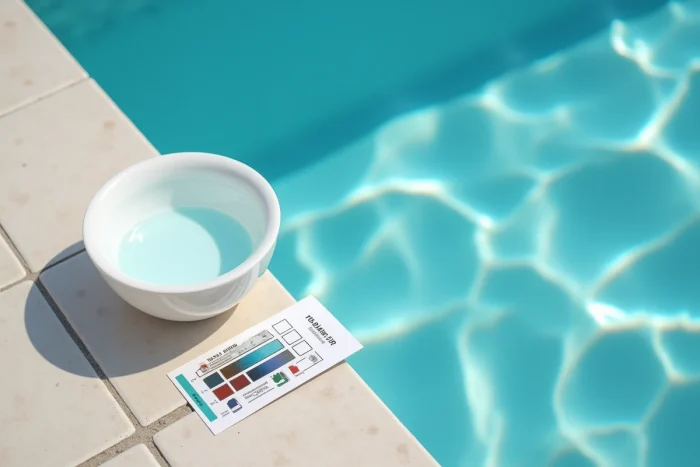
Hard filling water: adapting the strategy when TAC keeps rising
Since the watering and filling restrictions implemented in several departments in 2022-2023, many owners compensate for evaporation with well or borehole water, often heavily loaded with carbonates. Pool professionals report a notable increase in TAC exceeding the target range in these contexts.
Without treating the makeup water, any TAC correction is temporary. Each refill reintroduces bicarbonates, and the cycle starts again. Two complementary approaches:
- Install a water softener or anti-limestone filter on the makeup circuit, which reduces TH and TAC of incoming water before it reaches the pool
- Split the refills into small volumes rather than a massive refill, to smooth the impact on the chemical balance
- Analyze the well water once a year (TH, TAC, pH, conductivity) to adjust the acid dosage to the actual water profile
Step-by-step TAC correction protocol without draining
We recommend a sequential approach rather than a single large-volume acid correction. Pouring the calculated dose all at once causes localized acid shock, even with filtration running, and can damage the coating near the injection point.
The step-by-step method involves splitting the total dose into three or four applications spaced four to six hours apart. Between each addition, measure the pH and TAC. As soon as the pH drops below 7.0, stop and let the aeration raise the pH before the next addition. This controlled back-and-forth between acid and aeration allows for gradual TAC reduction without ever leaving the pH comfort zone.
Filtration and mixing must run continuously throughout the correction phase. Stopping the pump between additions skews measurements, as stagnant water near the walls does not have the same chemical profile as circulating water.
A TAC that is too high is rarely corrected in a single intervention. For hard well water, expect two to three sessions spaced a week apart to sustainably stabilize alkalinity within the target range, without ever draining the pool.