
Building a new house is not just about choosing a plan and signing with a builder. A construction real estate project involves several years, requires technical decisions from the very first weeks, and has lasting financial consequences, particularly on insurance costs and credit conditions.
Energy performance and financing conditions: a direct link
Since the Climate and Resilience Law (law n°2021-1104 of August 22, 2021), French banks have incorporated an energy score into their risk analysis for mortgage loans. Several institutions, such as Crédit Agricole, BNP Paribas, and La Banque Postale, consider high-performing new homes (RE 2020, passive houses) to present a lower risk of depreciation.
This ranking can translate into more favorable credit conditions for projects deemed virtuous. Conversely, a project whose technical choices fall short of RE 2020 expectations risks facing less advantageous conditions.
The common reflex is to first validate the overall budget and then address the energy aspect. This approach poses a problem. The level of thermal performance chosen directly influences the financial setup. Anyone wishing to build with Bâtir Architecte and maisonluminea fr should consider the energy question even before the first bank appointment.
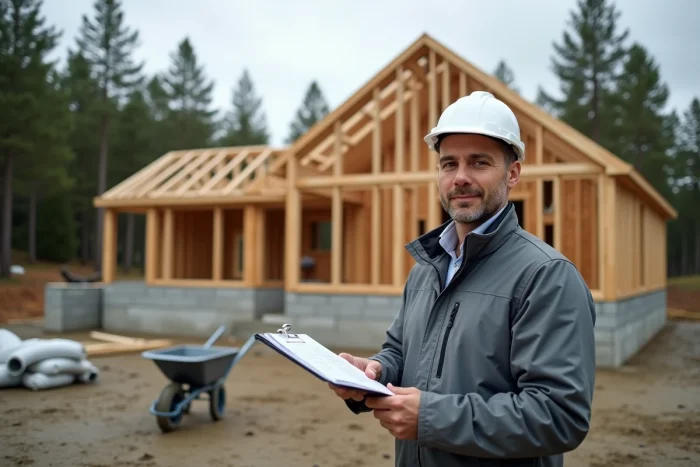
Home insurance and thermal standards: check before the building permit
Since 2023-2024, major home insurance companies in France (Groupama, MAIF, Allianz, among others) have added specific clauses related to energy performance in their contracts for new homes. Some apply surcharges or exclusions of coverage in case of non-compliance with the RT 2012 or RE 2020 standards specified in the initial contract.
The trap is real. A change in insulation material during construction (for budget or availability reasons) can render the house non-compliant with the technical description provided to the insurer. The builder’s ten-year warranty covers defects, but not a deliberate deviation from contractual specifications.
What the insurer expects before signing
- The consistency between the technical description of the building permit and the thermal performance stated in the insurance contract
- A heating system compatible with RE 2020 requirements, documented in the CCMI (individual house construction contract) or the architect’s contract
- The provision of the thermal compliance certificate at the end of the construction, without which certain guarantees may be suspended
Checking the compatibility between technical choices and insurance conditions from the design phase avoids costly disputes at the project handover.
Choosing the land: what the soil imposes on the construction project
The land conditions a part of the budget that most buyers underestimate. Beyond location and size, it is the nature of the soil that determines the type of foundations, thus leading to a sometimes heavy budget line.
A geotechnical study (G2 soil study) is mandatory in areas with medium to high exposure to clay shrink-swell. This study determines whether deep foundations, micropiles, or a slab will be necessary, three solutions with significantly varying costs.
An apparently flat plot may hide a high water table or old fill. In such cases, the additional cost of foundations can represent a significant fraction of the total construction budget. Having the soil study conducted before signing the sales deed (and not after) allows for renegotiating the land price or withdrawing without penalty if the results reveal difficult soil conditions.

Ambiance notebook and functional program: framing the project before the plans
Professionals recommend validating an ambiance notebook before starting architectural design. This document gathers the intentions of the project owner: desired materials, levels of brightness per room, specific uses (telecommuting, reduced mobility, space adaptability).
This notebook does not replace the functional program, which lists the surfaces, number of rooms, and technical constraints. The two documents complement each other. The functional program answers the question “how many and where,” while the ambiance notebook answers “how and why.”
Why this tool changes the relationship with the builder
Without an ambiance notebook, exchanges with the architect or builder revolve around 2D plans. Misunderstandings then focus on details that are not details: ceiling height, orientation of bay windows, acoustic treatment between rooms.
Formalizing these expectations in writing before the first sketch reduces the number of back-and-forths and limits amendments during construction. An amendment signed after the start of work always costs more than the same modification integrated during the design phase.
Site monitoring: key checkpoints not to delegate
Site monitoring is often seen as a formality reserved for the project manager. However, the project owner (the individual building) retains an active role at several key stages.
- Verification of the ground layout before pouring the foundations to ensure that the house complies with regulatory distances and the planned orientation
- Control of reservations (duct passages, locations of outlets and water inlets) at the time of the second work, as corrections after closing the partitions multiply costs
- Acceptance of the work with a detailed report, noting every visible reservation, even minor, to activate the guarantee of perfect completion
Acceptance remains the most legally binding moment for the project owner. A signed report without reservations makes any subsequent claims on apparent defects very difficult. Taking the time to note every anomaly, even cosmetic, protects throughout the duration of the ten-year warranty.
A successful construction project relies less on the finishes than on the decisions made during the first three months: soil study, thermal arbitration, framing of the ambiances. It is these early choices that determine the final budget and the strength of the insurance coverage.