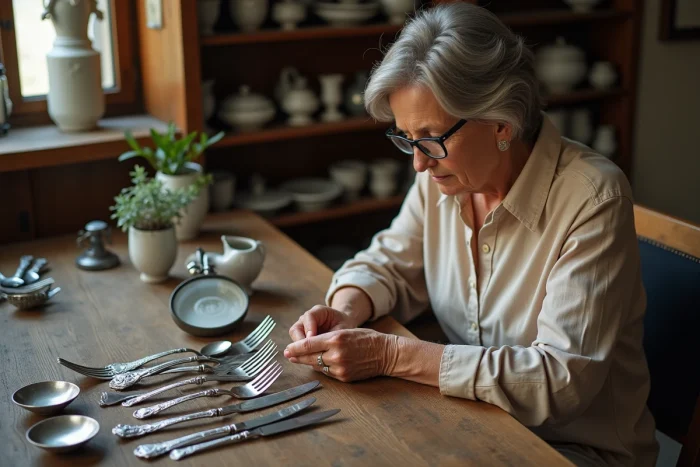
Estimating the value of Christofle cutlery involves distinguishing what the hallmark truly indicates from what one projects onto it. The name Christofle alone is not enough to set a price: the company has been producing both electroplated metal and solid silver since 1830, and the value differences between these two categories are considerable. It is the precise reading of the old hallmarks that allows for a clear decision.
Electroplating and Christofle Hallmarks: What the Technique Changes in Valuation
In 1842, Charles Christofle acquired the patents for electrolytic silvering and gilding. For a decade, he remained the only manufacturer in France authorized to use this process. Electroplating deposits a layer of silver onto an alloy base, giving an appearance identical to solid silver at a much lower cost.
This technical distinction is the first filter for valuation. The majority of Christofle’s production is in electroplated metal, not solid silver. Confusing the two leads to overvaluing or undervaluing an entire service. The hallmark is the only objective element to differentiate the pieces.
To correctly assess the price of Christofle silver cutlery, one must cross-reference the type of hallmark with the model and the period of manufacture. A master silversmith’s hallmark (diamond shape with the manufacturer’s initials) indicates solid silver, while a simple Christofle marking accompanied by a reference number indicates electroplated metal. Both can have value, but not for the same reasons.
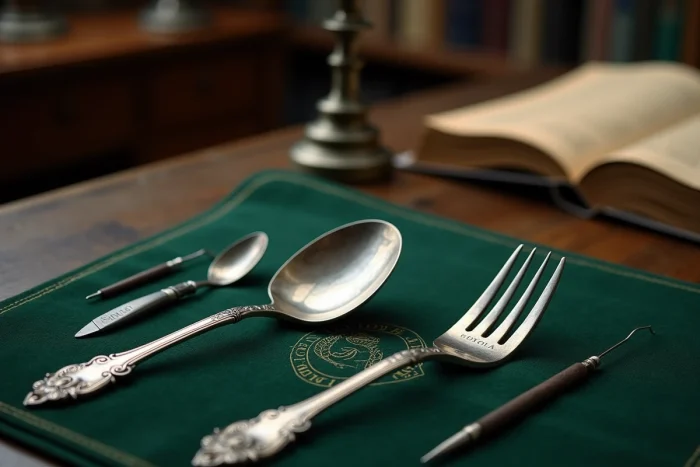
Guarantee Hallmarks on Christofle Solid Silver: Identifying the Manufacturing Period
On a piece of solid silver, the guarantee hallmark is applied by the customs or guarantee office, not by the manufacturer. It is a state marking that certifies the metal’s fineness. Its shape varies according to the period.
- The Minerva (helmeted head, right profile) accompanied by a number (1 or 2) indicates the silver’s fineness. The number 1 corresponds to the highest fineness. This hallmark has been used since 1838 and remains in effect.
- The old man hallmark (profile head in an oval) indicates a piece made before 1838, falling under the old guarantee system. Its presence on a Christofle cutlery piece is rare, as the company started in 1830.
- The master silversmith’s hallmark, in diamond shape, bears the manufacturer’s initials framing a symbol. For Christofle, this diamond has evolved over the decades, allowing for a fairly precise dating of the piece.
An absent or illegible guarantee hallmark complicates any reliable valuation. The wear on antique cutlery, especially on knife handles, can make the marking indecipherable. In this case, only a physical test (touchstone or analysis) can confirm the nature of the metal.
Christofle Electroplated Metal: Markings That Mislead Sellers
Most Christofle cutlery found in estates is made of electroplated metal. They bear specific markings that are not legal guarantee hallmarks but manufacturer marks.
Typically, one finds the name Christofle engraved or stamped, accompanied by numbers like 84 or 33. These numbers do not indicate a silver fineness but a silvering weight deposited on the surface. The number indicates the amount of precious metal used to silver a batch of pieces. A higher weight implies a thicker layer, thus greater durability, but not a more noble metal.
This confusion is common during resale between individuals. A service marked “Christofle 84” is not solid silver of fineness 84. Field returns vary on this point: some sellers attribute a value to these markings that they do not possess, while informed buyers use this ignorance to negotiate down.
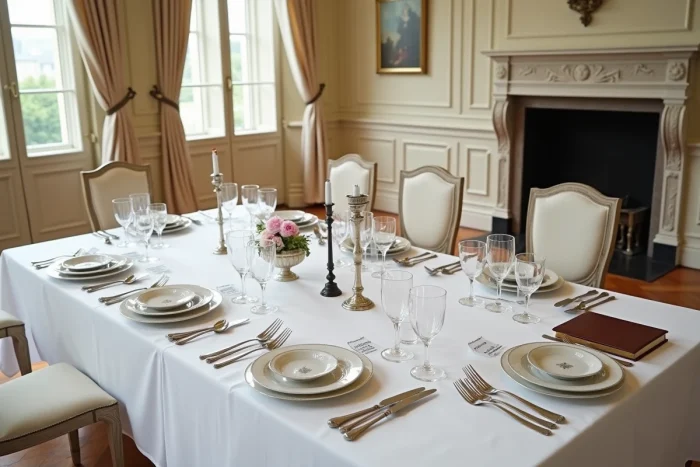
Model, Completeness, and Condition: Criteria as Important as the Hallmark
The hallmark determines the nature of the metal. The rest of the valuation depends on factors that the marking does not reveal.
The completeness of a cutlery set directly influences its valuation at auction. An incomplete service loses a significant part of its value, even if each piece bears an intact hallmark. Recent auction catalogs show that Christofle electroplated cutlery continues to be actively traded, with results varying greatly depending on the number of pieces and their condition.
The model also plays a crucial role. Some series created in collaboration with renowned designers (Gio Ponti in 1928, Lino Sabattini in 1957) fetch prices higher than solid silver pieces of common models. Prestigious commissions, such as the table centerpieces made for Napoleon III at the Tuileries or the cutlery from the ocean liner Normandie, have generated series whose surviving pieces are particularly sought after.
What Influences Price Up or Down for the Same Model
- The condition of the silvering: on electroplated metal, areas where the base metal appears (copper or nickel silver) indicate advanced wear and reduce appeal to a buyer.
- The presence of engraved monograms: a family initial may appeal to a collector or deter a buyer looking for a neutral service.
- The original packaging: a period Christofle case adds to perceived value, especially for models predating 1950.
Christofle has also launched a platform for acquiring old pieces from individuals, creating a valuation channel distinct from auctions and antique dealers. This program concerns pieces identifiable by their markings, confirming that the readability of the hallmark remains the starting point for any valuation process.
Reading a Christofle hallmark is akin to making a technical diagnosis before any value projection. Without this step, the risk of confusing electroplated metal and solid silver turns an estimation into a gamble. The available data do not allow for universal price ranges: each piece is a particular case where the hallmark opens the door but never closes the question alone.